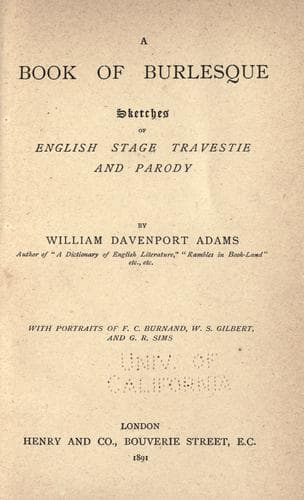
A Book of Burlesque: Sketches of English Stage Travestie and ParodyAdams, William Davenport
History
A Book of Burlesque: Sketches of English Stage Travestie and Parody
Adams, William Davenport
Burlesque (Literature); English literature -- History and criticism; Parody
During the present year, the interest gradually excited by successive
performances of plays by Henrik Ibsen has culminated in the production
of the inevitable burlesques. More than one clever travestie of Ibsen
has been printed--_e.g._, those by Mr. J. P. Hurst and Mr. Wilton
Jones; but the first to be performed was that entitled "Ibsen's
Ghost, or Toole up to Date," which is from the witty pen of Mr. J.
M. Barrie. This starts as a sort of sequel to "Hedda Gabler," which
it mainly satirises; but there are allusions also to "Ghosts" and
to "A Doll's House," with some general sarcasm at the expense of
Ibsen's peculiarities. The dialogue is in prose, with a concluding
vocal quartett; the writer's touch is as light as it is true; and the
composition, as a whole, is thoroughly exhilarating. The three-act
piece, "The Gifted Lady," in which Mr. Robert Buchanan sought to
ridicule not only Ibsen but other "emancipating" agencies of the time,
was, unfortunately, not so successful as Mr. Barrie's slighter and
brighter work. It abounded in excellent epigram, but lacked geniality
and humour. In "Ibsen's Ghost" Mr. Toole and Miss Eliza Johnstone
renewed old successes, while Miss Irene Vanbrugh gave signs of aptitude
for burlesque. In "The Gifted Lady" Miss Fanny Brough, Miss Cicely
Richards, Mr. W. H. Vernon, and Mr. Harry Paulton showed all their
usual skill, but, unfortunately, to no purpose.
VIII.
BURLESQUE OF OPERA.
We have already seen that, in burlesquing mythology, faërie, and
other matters, our comic playwrights have not been able to resist the
temptation to introduce occasional travesties of things operatic.
Opera, indeed, has always had a magnetic power over them. They have
been unable to maintain their gravity in presence of the singularities
which distinguish opera, even in its most modern guise, from the more
natural and realistic drama. Operatic conditions demand, of necessity,
certain stereotyped regulations, especially of stage management, which
detract from probability and excite derision. Especially is this so
in the case of the older school of Opera, and notably in that of the
Italian school, whose products were largely on the same simple and
ingenuous model--a model on which the travestie writers were able to
construct some genuinely entertaining imitations.
Public-domain text, read in full here on John Shaqi.
Reviews
Reviews
No reviews yet
Be the first to share your thoughts on this work.
Elsewhere in the archive
Join the Discussion
Join the discussion
Sign in to leave a comment or review.
Sign InorCreate an account