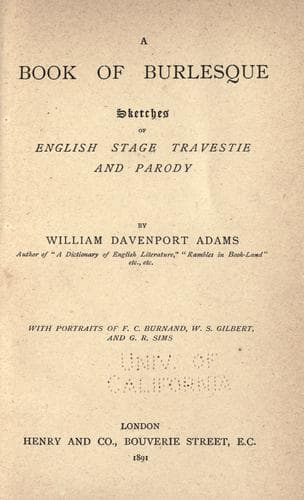
A Book of Burlesque: Sketches of English Stage Travestie and ParodyAdams, William Davenport
History
A Book of Burlesque: Sketches of English Stage Travestie and Parody
Adams, William Davenport
Burlesque (Literature); English literature -- History and criticism; Parody
Turning to the burlesques of opera of the German school, we begin,
naturally, with Mozart, whose "Don Giovanni" found humorous reflection
in two pieces, by H. J. Byron and Mr. Reece. The former's "Little Don
Giovanni"[45] belongs to 1865, when it was performed at the Prince
of Wales's, with Miss Wilton (Mrs. Bancroft) as the hero, Clarke as
Leporello, Miss Fanny Josephs as Masetto, Mr. Hare as Zerlina (probably
his only appearance on the stage in petticoats), Miss Sophie Larkin
as Elvira, and Miss Hughes as Donna Anna. Don Giovanni was the last
burlesque part written by Byron for Miss Wilton, and, moreover, it was
the last burlesque part she ever played. She records in her Memoirs
that an amusing feature of the piece was the spectacle presented in
the last act by the Commandant's horse, which, in allusion to a recent
freak in Leicester Square, had been covered with a variety of spots,
and "looked like an exaggerated Lowther Arcade toy." Mr. Reece's
burlesque was called "Don Giovanni in Venice," and came out at the
Gaiety in 1873.
[45] Byron's "Don Juan," brought out at the Alhambra in 1873, was
about equally indebted for its plot to the libretto of Mozart's
opera and to Lord Byron's poem.
In 1842 Macready revived at Drury Lane Handel's delightful "Acis and
Galatea," and the opera was promptly caricatured by W. H. Oxberry in a
piece produced three days afterwards at the Adelphi. The travestie of
"Acis and Galatea" which was seen at the Olympic in 1863 was from the
pen of Mr. Burnand. Its full title was "Acis and Galatea, or the Nimble
Nymph and the Terrible Troglodyte"; and the Nimble Nymph (described
as "a Nymph of the Sea, who also visits the land--a nymphibious young
lady") was played by Miss Hughes. The puns were prolific, and so were
the parodies, the best of which are written in caricature of the absurd
English translations in the operatic "books of the play." Here, for
example, is a setting of the trio in "Trovatore"--"Il tuo sangue":--
_Polyphemus._ With you, oh, sanguine, I'd share your 'art, oh!
'Twould be a stinger, ho! if no go.
(_As to her_) Dear! (_as to himself_) Oh, folly! be calm, oh!
I'm misty!
(_Holding his hands over his bursting heart--operatically singing_).
Eh, pooh, we've here a lump, oh! (_alluding to his heart_).
No, eh, pooh, we've 'ere a
Lump, oh no.
Ah! de gal, oh, so de gal, oh, so coy, press 'art to (_enraptured_)
And it may then end in no go! (_with a tinge of sadness_).
And it may then end in no go!
I'm a gent, oh, over-misty (_with his hand to his heart_),
Cease of her to be fond, ah, no!
No! fond! ah! no!
Ah! etc.
_Phyllis._ {Come, ah! come, will you o-ver-awe, eh? (_fiercely_).
_Galatea._ {Come, ah! come, will you o-ver-awe me? (_distractedly_).
Public-domain text, read in full here on John Shaqi.
Reviews
Reviews
No reviews yet
Be the first to share your thoughts on this work.
Elsewhere in the archive
Join the Discussion
Join the discussion
Sign in to leave a comment or review.
Sign InorCreate an account