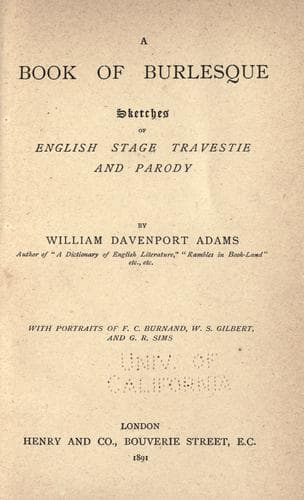
A Book of Burlesque: Sketches of English Stage Travestie and ParodyAdams, William Davenport
History
A Book of Burlesque: Sketches of English Stage Travestie and Parody
Adams, William Davenport
Burlesque (Literature); English literature -- History and criticism; Parody
_Phyllis._ {You'll ar-ray, ah! wi' Pol trudge, oh![46] (_fiercely_).
_Galatea._ {You'll ar-ray, ah! wi' Pol trudge, oh! (_distractedly_).
_Phyllis._ {Veep! ye'll ne'er go to rest o' shore, eh! (_fiercely_).
_Galatea._ {Veep! we'll ne'er go to rest o' shore, eh?
(_distractedly_).
_Phyllis._ {Gay! tomb! ah! one full! no beau!
(_wildly and demoniacally_).
_Galatea._ {Gay! tomb! ah! one full! no beau!
(_wildly and distractedly_).
[46] This, says Mr. Burnand in a note, is the poetic for "You'll get on
your bonnet and accompany Polyphemus."
Six years after the production of Mr. Burnand's piece, Mr. T. F.
Plowman brought out at Oxford "a piece of extravagance," to which he
gave the name of "A Very New Edition of Acis and Galatea, or the Beau!
the Belle! and the Blacksmith!"
Of Meyerbeer's operas three have been burlesqued in England--"Dinorah,"
"L'Africaine" and "Robert le Diable." The first of these was parodied
in "Dinorah under Difficulties," a burlesque by William Brough, which
dates back as far as 1859 (at the Adelphi). "L'Africaine" was handled
by Mr. Burnand six years later at the Strand. Three years more, and
"Robert le Diable" was being travestied at the Gaiety by Mr. Gilbert,
under the title of "Robert the Devil, or the Nun, the Dun, and the Sun
of a Gun."[47] This last is on the old lines of "palmy-day" burlesque,
and has not much in it that is characteristically Gilbertian. The
lyrics are written chiefly to operatic airs, and there is no room,
therefore, for rhythmical invention. In the dialogue, however, one
comes across an occasional passage which strikes one as quite
Gilbertian in its cynicism. Take, for example, these lines from the
scene in which fun is made of the Tussaud "Chamber of Horrors":--
[47] In this Miss Farren, as Robert, was supported by Miss Constance
Loseby as Raimbault, Miss Emily Fowler as Alice, Miss Annie Tremaine as
Prince of Granada, and Joseph Eldred as Gobetto.
_Bertram._ These are all statues, raised from time to time
To people who're remarkable for crime.
_Robert._ But if their wicked deeds could so unnerve one,
Why give them statues?
_Bert._ 'Cause they don't deserve one.
That's our strict rule--a rule we never garble--
Good deeds we write in sand, bad deeds in marble.
Some of the puns in the piece are worth recording. Thus, Alice says of
a porter, to whom half a crown has been given:--
He'll spend it all upon his favourite wets--
He tipsy gets with all the _tips he gets_.
Again, Gobetto says of Robert:--
He's smoking to a pretty tune, I'll bet, oh!
_Prince._ That pretty tune must be "Il Cigaretto."
Gobetto says to Robert:--
We saw you through the window, pouring fizz in!
_Robert._ I liked the wines, but didn't like the _quizzin_.
Again:--
Public-domain text, read in full here on John Shaqi.
Reviews
Reviews
No reviews yet
Be the first to share your thoughts on this work.
Elsewhere in the archive
Join the Discussion
Join the discussion
Sign in to leave a comment or review.
Sign InorCreate an account