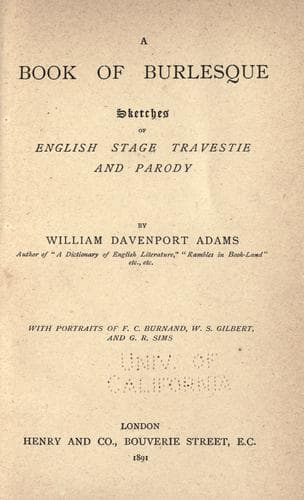
A Book of Burlesque: Sketches of English Stage Travestie and ParodyAdams, William Davenport
History
A Book of Burlesque: Sketches of English Stage Travestie and Parody
Adams, William Davenport
Burlesque (Literature); English literature -- History and criticism; Parody
Dividing Song for the moment into Poem and Ballad, we note that the
poems of Lord Byron have been the inspiring cause of at least four
notable burlesques. His lordship's "Don Juan" suggested the "Beautiful
Haidee" of H. J. Byron (1863) and the "Don Juan Junior" of the
"Brothers Prendergast" (1880); while his "Corsair" is the basis of
William Brough's "Conrad and Medora" (Lyceum, 1856), and his "Bride
of Abydos" prompted the piece with the same title which H. J. Byron
wrote for the Strand Theatre. In "Conrad and Medora" Miss Marie Wilton
was "the Little Fairy at the Bottom of the Sea," the title-parts being
given to Miss Woolgar and Mrs. Charles Dillon, and that of Birbanto
to Mr. Toole. The Bride of Abydos--Zuleika--had Miss Oliver for her
representative.
With Byron it seems natural to associate his friend Tom Moore, whose
"Lalla Rookh" has had exceptional favour with the parodists. Four of
these have been fascinated by her charms--Mr. J. T. Denny in 1885,
Mr. Horace Lennard in the previous year, Vincent Amcotts in 1866, and
last, but not least, William Brough (at the Lyceum) in 1857. It was to
be expected that, when travestying Moore, Brough should parody "The
Minstrel Boy," and so we have from him the following lines, sung by
Miss Woolgar as Feramorz:--
The minstrel boy through the town is known,
In each quiet street you'll find him,
With his master's organ--it is ne'er his own,
And his monkey led behind him.
"Straw laid down!" cries the minstrel boy,
"Some sick man here needs quiet;
'Bobbin' around' will this house annoy,
At any rate, I'll try it!"
The minstrel grinds, and his victims pay;--
To his claims he's forced compliance!
To the poet's study then he takes his way--
To the men of art and science.
And cries, "My friends, in vain you'd toil
At books, at pen, or easel;
One roving vagabond your work shall spoil,"--
He plays "Pop goes the Weasel."
Elsewhere, Namouna, the Peri, gave utterance to the following
reflections on the levelling power of love[53]:--
[53] Reminding one of H. J. Byron's couplet:--
Love levels all--it elevates the clown,
And often brings the fattest people down.
Love makes all equal--scorns of rank the rules;
Makes kings and beggars equal--equal fools.
Love brings (distinctions overboard all pitchin')
The low-born peeler to the grandee's kitchen;
Makes the proud heiress of paternal acres
Smile kindly on the young man from the baker's.
Kings will forget their state at love's dictation,
Cabmen their rank, and railway-guards their station.
Love makes the housemaid careless--masters wroth,
And makes too many cooks to spoil their broth.
In this piece Mrs. Charles Dillon was the Lalla Rookh, and Mr. Toole
represented "a fabulous personage, not found in the poem," called
Khorsanbad.
Public-domain text, read in full here on John Shaqi.
Reviews
Reviews
No reviews yet
Be the first to share your thoughts on this work.
Elsewhere in the archive
Join the Discussion
Join the discussion
Sign in to leave a comment or review.
Sign InorCreate an account