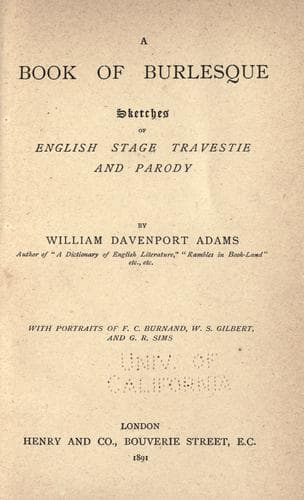
A Book of Burlesque: Sketches of English Stage Travestie and ParodyAdams, William Davenport
History
A Book of Burlesque: Sketches of English Stage Travestie and Parody
Adams, William Davenport
Burlesque (Literature); English literature -- History and criticism; Parody
One, at least, of our burlesque writers--Mr. Gilbert Arthur
a'Beckett--has had the courage to tackle a poem of Coleridge; to wit,
his "Christabel," from which, however, Mr. A'Beckett derived only
certain suggestions for his work. In his "Christabel, or the Bard
Bewitched," represented at the Court in 1872, the Bard, Bracy, was
played by Mr. Righton, who made a special feature of a travestie of Mr.
Irving in "The Bells." He pretended that he had murdered a muffin-man,
and that, consuming all he could of the muffins left in the man's
basket, he had deposited the remainder in the area. Miss Nelly Bromley
was the Christabel.
Scott's "Lady of the Lake" gave Mr. Reece the idea for a burlesque
performed at the Royalty in 1866. In the same year Andrew Halliday
brought out at the Adelphi a comic piece, happily entitled "The
Mountain Dhu, or the Knight, the Lady, and the Lake." Mr. Toole was the
impersonator of the Mountain Dhu, Paul Bedford the Douglas, Miss Hughes
the Malcolm Graeme, Miss Woolgar (Mrs. Mellon) the Fitzjames, and Miss
Furtado the Lady of the Lake. "The Lady of the Lane" was the title
given by H. J. Byron to the travestie from his pen which saw the light
at the Strand in 1872. In this case Mr. Edward Terry was the Roderick
and Miss Kate Bishop the Ellen, Mrs. Raymond making a great hit as the
demented Blanche.
Our present Laureate provoked in 1870 the satiric powers of Mr. W. S.
Gilbert, whose "Princess," played at the Olympic, was described by the
author as "a whimsical allegory," as well as "a respectful perversion
of Mr. Tennyson's poem."[54] In this production Mr. Gilbert wrote his
lyrics to the melodies of popular airs, after the manner of the time.
The major portion of the travestie is familiar to present-day audiences
as having formed, in the main, the text of "Princess Ida," for which
Sir Arthur Sullivan composed such charming music. Nevertheless, I
cannot refrain from quoting, as a happy specimen of Mr. Gilbert's
later manner in burlesque,[55] the speech addressed by the Princess
to her disciples--a speech marked by agreeable _naïvétè_ and happy
mock-heroics:--
[54] Mr. David Fisher was the King Hildebrand, and Miss Maria Simpson
(Mrs. W. H. Liston), his son Prince Hilarion; Miss Augusta Thomson
being the Cyril, Miss Mattie Reinhardt the Princess Ida, Miss Fanny
Addison the Lady Psyche, Mrs. Poynter the Lady Blanche, and Miss Patti
Josephs the Melissa.
[55] In a sense, all Mr. Gilbert's comic operas are burlesques, for
they are full of travestie, especially of the conventionalities of
grand opera and melodrama. At the same time, they cannot be called
burlesques in the everyday, theatrical sense of the term.
Public-domain text, read in full here on John Shaqi.
Reviews
Reviews
No reviews yet
Be the first to share your thoughts on this work.
Elsewhere in the archive
Join the Discussion
Join the discussion
Sign in to leave a comment or review.
Sign InorCreate an account