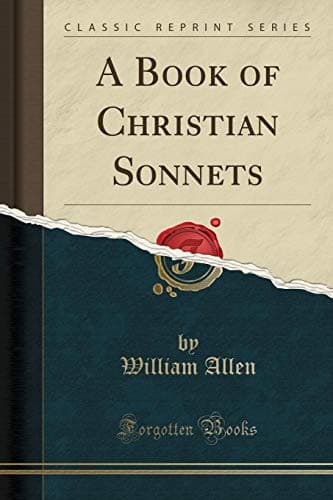
A BOOK OF CHRISTIAN SONNETS.
BY WILLIAM ALLEN, D. D.,
Late President of Bowdoin College; Author of the American Biographical
Dictionary, and of Wunnissoo or the Vale of Hoosatunnuk a Poem.
NORTHAMPTON:
PUBLISHED BY BRIDGMAN & CHILDS.
1860.
Metcalf & Company, Printers,
Northampton.
PREFACE.
For some remarks on the nature and history of the _Sonnet_ and its
peculiar excellence, as exemplified by Milton, the reader is referred
to the Notes at the close of this book. The Author regards it as by
its fixed laws and its structure the very best form of poetry for one
short, complete, meditative lesson. A collection of such distinct,
separate little poems,――mostly written within a recent period,――and not
mingled with other forms of poetry,――constitutes this little volume.
The notes annexed are historical and illustrative, elucidatory of
what from the necessary brevity of the verse might be otherwise left
obscure, or such as seemed to be required by the unevasible claims and
the infinite worth of the revealed Christian truth, which makes the
texture of these sonnets.
While Petrarch, the inventor of the _Sonetto_, Spenser, Shakespeare,
Wordsworth, and other foreign poets have written a multitude of
sonnets, it is to the author a matter of surprise, that not more than
half a dozen sonnets――within his knowledge――have ever been sent forth
by any one of our poets; so that this may be regarded as the first book
of American Sonnets ever published.
An old man, the tenant for a year past of a sick chamber, who from
early life has been a student and cultivator of poetry, has found not
a little pleasure in such musings, as he now offers to the public.
His meditations, it may well be supposed, have not been of fictitious
scenes. Aware of his liableness at any moment to be summoned away from
this world,――which to his eye is filled with beauty mingled indeed with
deformity,――into a world of undefaced loveliness and eternal glory,
he could not have excused himself, if he had employed the precarious
time lent to him in drawing idle, uninstructive, unprofitable pictures;
but his mind has been filled with intense thoughts on God's pure,
unchanging, soul-saving Truth; and he has endeavored to give true
sketches, however faint and feeble, of divine and eternal realities not
unworthy of the contemplation nor unfit to awaken the affections of
rational, immortal men. The uninterrupted study of God's Word for 50
or 60 years may be his apology for declaring what in his judgment are
plainly and indubitably some of the great truths of that Word. But he
earnestly asks the reader to search the Scriptures with his own eyes.
What God has said is true.
Northampton, Dec. 19, 1859
CONTENTS.
Sonnet Page
Public-domain text, read in full here on John Shaqi.
Reviews
Reviews
No reviews yet
Be the first to share your thoughts on this work.
Join the Discussion
Join the discussion
Sign in to leave a comment or review.
Sign InorCreate an account