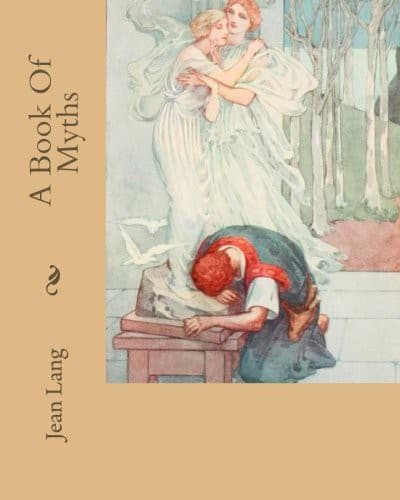
Mythology; Mythology, Greek -- Juvenile literature
He rose to great power, and became a mighty prince of Thrace. Not his
lute alone, but he himself played on the heart of the fair Eurydice
and held it captive. It seemed as though, when they became man and
wife, all happiness must be theirs. But although Hymen, the god of
marriage, himself came to bless them on the day they wed, the omens on
that day were against them. The torch that Hymen carried had no golden
flame, but sent out pungent black smoke that made their eyes water.
They feared they knew not what; but when, soon afterwards, as Eurydice
wandered with the nymphs, her companions, through the blue-shadowed
woods of Thrace, the reason was discovered. A bold shepherd, who did
not know her for a princess, saw Eurydice, and no sooner saw her than
he loved her. He ran after her to proclaim to her his love, and she,
afraid of his wild uncouthness, fled before him. She ran, in her
terror, too swiftly to watch whither she went, and a poisonous snake
that lurked amongst the fern bit the fair white foot that flitted,
like a butterfly, across it. In agonised suffering Eurydice died. Her
spirit went to the land of the Shades, and Orpheus was left
broken-hearted.
The sad winds that blow at night across the sea, the sobbing gales
that tell of wreck and death, the birds that wail in the darkness for
their mates, the sad, soft whisper of the aspen leaves and the leaves
of the heavy clad blue-black cypresses, all now were hushed, for
greater than all, more full of bitter sorrow than any, arose the music
of Orpheus, a long-drawn sob from a broken heart in the Valley of the
Shadow of Death.
Grief came alike to gods and to men as they listened, but no comfort
came to him from the expression of his sorrow. At length, when to bear
his grief longer was impossible for him, Orpheus wandered to Olympus,
and there besought Zeus to give him permission to seek his wife in the
gloomy land of the Shades. Zeus, moved by his anguish, granted the
permission he sought, but solemnly warned him of the terrible perils
of his undertaking.
But the love of Orpheus was too perfect to know any fear; thankfully
he hastened to the dark cave on the side of the promontory of
Taenarus, and soon arrived at the entrance of Hades. Stark and grim
was the three-headed watchdog, Cerberus, which guarded the door, and
with the growls and the furious roaring of a wild beast athirst for
its prey it greeted Orpheus. But Orpheus touched his lute, and the
brute, amazed, sank into silence. And still he played, and the dog
would gently have licked the player's feet, and looked up in his face
with its savage eyes full of the light that we see in the eyes of the
dogs of this earth as they gaze with love at their masters. On, then,
strode Orpheus, playing still, and the melody he drew from his lute
passed before him into the realms of Pluto.
Public-domain text, read in full here on John Shaqi.
Reviews
Reviews
No reviews yet
Be the first to share your thoughts on this work.
Join the Discussion
Join the discussion
Sign in to leave a comment or review.
Sign InorCreate an account