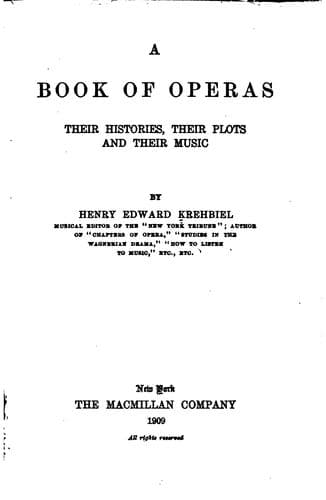
A Book of Operas: Their Histories, Their Plots, and Their MusicKrehbiel, Henry Edward
History
A Book of Operas: Their Histories, Their Plots, and Their Music
Krehbiel, Henry Edward
Operas -- Stories, plots, etc.
Once upon a time, in the course of a hunt,
the dogs started a stag who bounded toward the party with a man tied
to his back. It was thus that poachers were sometimes punished. The
Prince's pity was stirred, and he promised that whoever should shoot
the stag without harming the man should receive the office of Chief
Forester, to be hereditary in the family, and the tenancy of a
hunting lodge near by. Cuno, moved more by pity than hope of reward,
attempted the feat and succeeded. The Prince kept his promise, but
on a suggestion that the old hunter may have used a charmed bullet,
he made the hereditary succession contingent upon the success of a
trial shot. Before telling the tale, Cuno had warned Max to have a
care, for should he fail in the trial shot on the morrow, his
consent to the marriage between him and Agathe would be withdrawn.
Max had suspected that his ill luck for a month past, during which
time he had brought home not a single trophy of bird or beast, was
due to some malign influence, the cause of which he was unable to
fathom. He sings of the prowess and joys that once were his (Aria:
"Durch die Wälder, durch die Auen"), but falls into a moody dread at
the thought that Heaven has forsaken him and given him over to the
powers of darkness. It is here that the sinister music, mentioned in
the outline of the overture, enters the drama. It accompanies the
appearance of Samiel (the Wild Huntsman, or Black Hunter,--in short,
the Devil), and we have thus in Von Weber's opera a pre-Wagnerian
example of the Leitmotif of the Wagnerian commentators. Caspar
returns to the scene, which all the other personages have left to
join in a dance, and finds his associate in the depths of despair.
He plies Max with wine, and, affecting sympathy with him in his
misfortunes, gradually insinuates that there is a means of insuring
success on the morrow. Max remains sceptical until Caspar hands
him his rifle and bids him shoot at an eagle flying overhead. The
bird is plainly out of rifle range, a mere black dot against the
twilight sky; but Max, scarcely aiming, touches the trigger and an
eagle of gigantic size comes hurtling through the air and falls at
his feet. Max is convinced that there is a sure way to win his
bride on the morrow. He asks Caspar if he has more bullets like the
one just spent. No; that was the hunter's last; but more might be
obtained, provided the effort be made that very night. The moment
was propitious. It was the second of three days in which the sun was
in the constellation of the Archer; at midnight there would occur an
eclipse of the moon. What a fortunate coincidence that all the omens
should be fair at so momentous a juncture of Max's affairs! The fear
of losing his bride overcomes Max's scruples; he agrees to meet the
tempter in the Wolf's Glen, a spot of evil repute, at midnight, and
at least witness the casting of more of the charmed bullets.
Public-domain text, read in full here on John Shaqi.
Reviews
Reviews
No reviews yet
Be the first to share your thoughts on this work.
Elsewhere in the archive
Join the Discussion
Join the discussion
Sign in to leave a comment or review.
Sign InorCreate an account