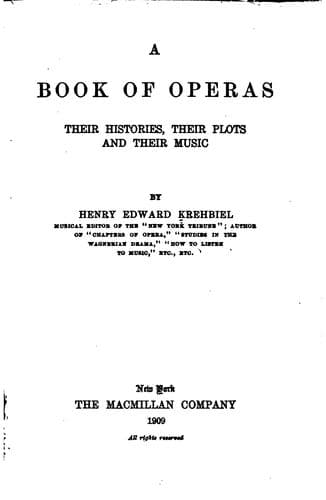
A Book of Operas: Their Histories, Their Plots, and Their MusicKrehbiel, Henry Edward
History
A Book of Operas: Their Histories, Their Plots, and Their Music
Krehbiel, Henry Edward
Operas -- Stories, plots, etc.
At the moment when Max's shot brought down the eagle, a portrait of
the original Cuno fell from the wall of the cottage occupied by his
descendant; and when the second act begins, we see Aennchen, a
cousin of Agathe's, putting it back in its place. Aennchen is
inclined to be playful and roguish, and serves as a pretty foil to
the sentimental Agathe. She playfully scolds the nail which she is
hammering into the wall again for so rudely dropping the old ranger
to the floor, and seeks to dispel the melancholy which has obsessed
her cousin by singing songs about the bad companionship of the blues
and the humors of courtship. She succeeds, in a measure, and Agathe
confesses that she had felt a premonition of danger ever since a
pious Hermit, to whom she had gone for counsel in the course of the
day, had warned her of the imminency of a calamity which he could
not describe. The prediction seemed to have been fulfilled in the
falling of the picture, which had slightly hurt her, but might
easily have killed her. Aennchen urges her to go to bed, but she
refuses, saying she shall not retire for sleep until Max has come.
Agathe sings the scena which has clung to our concert-rooms as
persistently as the overture. The slow portion of the aria ("Leise,
leise, fromme Weise"), like the horn music at the beginning of the
overture, has found its way into the Protestant hymn-books of
England and America, and its Allegro furnishes forth the jubilant
music of the instrumental introduction to the opera. Berlioz in his
book "A Travers Chants" writes in a fine burst of enthusiasm of this
scena: "It is impossible for any listener to fail to hear the sighs
of the orchestra during the prayer of the virtuous maiden who awaits
the coming of her affianced lover; or the strange hum in which the
alert ear imagines it hears the rustling of the tree-tops. It even
seems as if the darkness grew deeper and colder at that magical
modulation to C major. What a sympathetic shudder comes over one at
the cry: ''Tis he! 'tis he!' No, no. It must be confessed, there
is no other aria as beautiful as this. No master, whether German,
Italian, or French, was ever able to delineate, as is done here in
a single scene, holy prayer, melancholy, disquiet, pensiveness, the
slumber of nature, the mysterious harmony of the starry skies, the
torture of expectation, hope, uncertainty, joy, frenzy, delight,
love delirious! And what an orchestra to accompany these noble song
melodies! What inventiveness! What ingenious discoveries! What
treasures of sudden inspiration! These flutes in the depths; this
quartet of violins; these passages in sixths between violas and
'cellos; this crescendo bursting into refulgence at the close; these
pauses during which the passions seem to be gathering themselves
together in order to launch their forces anew with greater
vehemence! No, this piece has not its fellow! Here is an art that
is divine! This is poetry; this is love itself!"
Public-domain text, read in full here on John Shaqi.
Reviews
Reviews
No reviews yet
Be the first to share your thoughts on this work.
Elsewhere in the archive
Join the Discussion
Join the discussion
Sign in to leave a comment or review.
Sign InorCreate an account