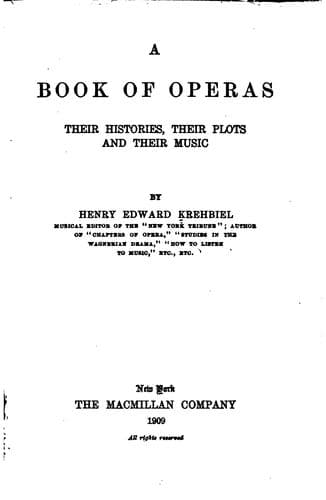
A Book of Operas: Their Histories, Their Plots, and Their MusicKrehbiel, Henry Edward
History
A Book of Operas: Their Histories, Their Plots, and Their Music
Krehbiel, Henry Edward
Operas -- Stories, plots, etc.
There are texts in the prefatory excerpt for a discussion of
"Tannhäuser" from all the points of view which might make such a
discussion interesting and profitable. There is no doubt in my mind
that it is the poet-composer's noblest tragedy and, from a literary
point of view, his most artistic. It is laid out on such a broad,
simple, and symmetrical plan that its dramatic contents can be set
forth in a few paragraphs, and we can easily forego a detailed
description of its scenes. A knightly minstrel, who has taken part
in one of the tournaments of song which tradition says used to be
held at the court of the Landgrave of Thuringia in the early part of
the thirteenth century, has, by his song and bearing, won the heart
of Elizabeth, niece of the Landgrave. Unmindful of his great good
fortune, he has found his way to the court held by the Goddess of
Love within the hollow of the Hörselberg, which lies across the
valley and over against the Wartburg. Dame Venus herself becomes
enamoured of the knight, who calls himself Tannhäuser, and for a
year and a day he remains at her side and in her arms. At length,
mind and senses surfeited, a longing seizes him for the world which
he has abandoned, for the refreshing sights and sounds of earth,
and even for its pains. Dame Venus seeks to detain him, but he is
resolute to leave her and her realm. Like a true knight, however, he
promises to sing her praises wherever he may go; but when she offers
to welcome him again if he should weary and sicken of the world and
seek redemption from its hypocrisies, he replies that for him
redemption rests only in the Virgin Mary. The invocation breaks the
bonds of enchantment which have held him. The scenes of allurement
which have so long surrounded him melt away, and he finds himself in
an attitude of prayer in a blooming valley below the Wartburg. It
is spring, and a shepherd lad, seated on a rock, trolls a lay to
spring's goddess. A troop of pilgrims passing by on their way to
Rome suggest by their canticle the need of absolution from the
burden of sin which rests upon him, but before he can join them, the
Landgrave and a hunting party come upon him. He is recognized by his
erstwhile companions in song, and consents to return to the castle
on being told by one of the minstrels, Wolfram von Esehenbach, that
his song had vanquished not only them, but the heart of the saintly
Elizabeth as well.
Public-domain text, read in full here on John Shaqi.
Reviews
Reviews
No reviews yet
Be the first to share your thoughts on this work.
Elsewhere in the archive
Join the Discussion
Join the discussion
Sign in to leave a comment or review.
Sign InorCreate an account