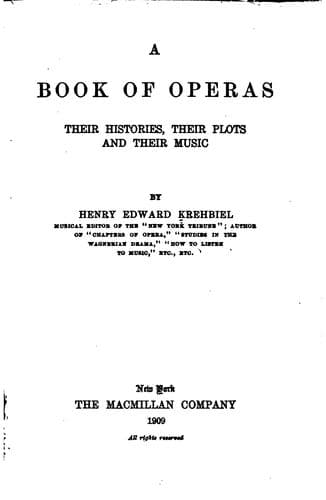
A Book of Operas: Their Histories, Their Plots, and Their MusicKrehbiel, Henry Edward
History
A Book of Operas: Their Histories, Their Plots, and Their Music
Krehbiel, Henry Edward
Operas -- Stories, plots, etc.
In the Wartburg Tannhäuser meets the maiden whose heart he has won
just after she has apostrophized the walls which had echoed his
voice; and from him she learns the meaning of the strange emotion
which fills her in his presence. Again minstrels gather before a
company of great nobles for a contest in the Hall of Song. Love is
to be the theme, and the hand of Elizabeth the reward of the victor.
Spiritual love is hymned by Tannhäuser's companions. Wolfram von
Eschenbach likens it to a pure fountain from which only high and
sacred feelings can flow. Tannhäuser questions the right of those
who have not experienced the passion as he has felt it to define the
nature of love. Goaded by the taunts and threats of rude Biterolf,
he bursts forth in a praise of Venus. The assembly is in commotion.
Swords are drawn. Sacrilege must be punished. Death confronts the
impiously daring minstrel. But Elizabeth, whose heart has been
mortally pierced by his words, interposes to save him. She has been
stricken, but what is that to his danger of everlasting damnation?
Would they rob his soul of its eternal welfare? The knight,
indifferent to a score of swords, is crushed by such unselfish
devotion, and humbly accepts the Landgrave's clemency, which spares
his life that he may join a younger band of pilgrims and seek
absolution at Rome. He goes to the Holy City, mortifying his flesh
at every step, and humbles himself in self-abasement and accusation
before the Pope; but only to hear from the hard lips of the Keeper
of the Keys that for such sin as his there is as little hope of
deliverance as for the rebudding of the papal staff.
The elder pilgrims return in the fall of the year, and Elizabeth
eagerly seeks among them for the face of the knight whose soul and
body she had tried to save. He is not among them. Gently she puts
aside the proffered help of Wolfram, whose unselfish love is ever
with her, climbs the hill to the castle, and dies. Famished and
footsore, Tannhäuser staggers after the band of pilgrims who
have returned to their homes with sins forgiven. His greeting of
Wolfram is harsh, but the good minstrel's sympathy constrains him to
tell the story of his vain pilgrimage. Salvation forfeited, naught
is left for him but to seek surcease of suffering in the arms of
Venus. Again he sees her grotto streaming with roseate light and
hears her alluring voice. He rushes forward toward the scene of
enchantment, but Wolfram utters again the name of her who is now
pleading for him before the judgment seat, of God Himself; and he
reels back. A funeral cortège descends from the castle. With an
agonized cry: "Holy Elizabeth, pray for me!" Tannhäuser sinks
lifeless beside the bier just as the band of younger pilgrims comes
from Rome bearing the crozier of the Pope clothed in fresh verdure.
They hymn the miracle of redemption.
* * *
Public-domain text, read in full here on John Shaqi.
Reviews
Reviews
No reviews yet
Be the first to share your thoughts on this work.
Elsewhere in the archive
Join the Discussion
Join the discussion
Sign in to leave a comment or review.
Sign InorCreate an account