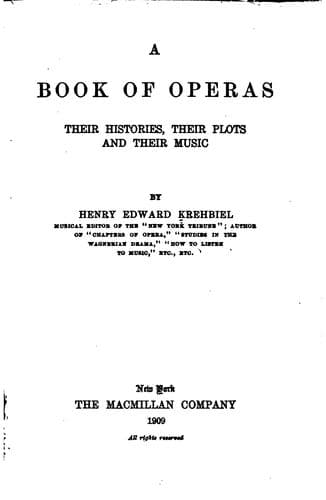
A Book of Operas: Their Histories, Their Plots, and Their MusicKrehbiel, Henry Edward
History
A Book of Operas: Their Histories, Their Plots, and Their Music
Krehbiel, Henry Edward
Operas -- Stories, plots, etc.
Wolfram von Eschenbach, Reinmar der Alte, Heinrich von Rispach,
Biterolf, Heinrich von Ofterdingen, and Klingesor. The subject
discussed by the minstrels was scholastic, and Ofterdingen, to save
his life, sought help of Klingesor, who was a magician and the
reputed nephew of Virgilius of Naples; and the Landgravine threw her
cloak around him when he was hardest pressed. This incident, its
ethical significance marvellously enhanced, is the culmination of
Wagner's second act. Instead of the historical Sophia, however, we
have in the opera Hermann's niece, Elizabeth, a creation of the
poet's, though modelled apparently after the sainted Elizabeth of
Hungary, who, however, had scarcely opened her eyes upon the world
in the Wartburg at the date ascribed to the contest, i.e. A.D. 1206.
Wagner has given the rôle played by Heinrich von Ofterdingen (also
Effterdingen) to Tannhäuser apparently on the strength of an essay
which appeared about the time that he took up the study of the
mediaeval legends of Germany, which identified the two men.
Ofterdingen himself is now thought to be a creation of some poet's
fancy; but the large part devoted to his adventure in the old poem
which tells of the contest of minstrelsy led the mediaeval poets to
attribute many great literary deeds to him, one of them nothing less
than the authorship of the "Nibelungenlied."
Wagner seems to have been under the impression that there was an old
book of folk-tales (a so-called Volksbuch) devoted to the story of
Tannhäuser and his adventure with Dame Venus. This is a mistake. The
legend came down to modern times by way of popular ballads. One of
these, which was printed by Uhland, consists largely of the dialogue
between Tannhäuser and his enslaver, as does also the carnival play
which Hans Sachs wrote on the subject. The writer of the ballad was
so energetic an enemy of the Papal power that he condemns Urban IV
to eternal torment because of his severe judgment of the penitent
sinner:--
Do was er widrumb in den berg
und het sein lieb erkoren,
des muoss der vierde babst Urban
auch ewig sein verloren.
Public-domain text, read in full here on John Shaqi.
Reviews
Reviews
No reviews yet
Be the first to share your thoughts on this work.
Elsewhere in the archive
Join the Discussion
Join the discussion
Sign in to leave a comment or review.
Sign InorCreate an account