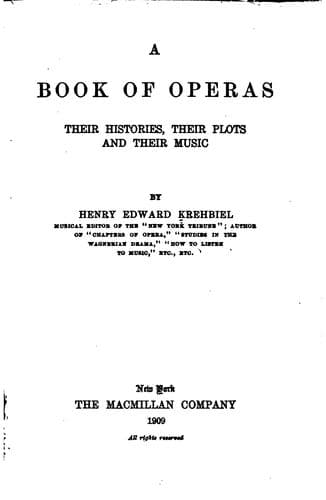
A Book of Operas: Their Histories, Their Plots, and Their MusicKrehbiel, Henry Edward
History
A Book of Operas: Their Histories, Their Plots, and Their Music
Krehbiel, Henry Edward
Operas -- Stories, plots, etc.
A ballad which was sung in one Swiss district as late as the third
decade of the nineteenth century gives the story of the knight and
his temptress in fuller detail, though it knows as little of the
episode of Elizabeth's love as it does of the tournament of song. In
this ballad Tannhäuser (or "Tanhuser") is a goodly knight who goes
out into the forest to seek adventures, or "see wonders." He finds
a party of maidens engaged in a bewildering dance, and tarries to
enjoy the spectacle. Frau Frene, or, as we would write it now, Freya
(the Norse Venus whose memory we perpetuate in our Friday), seeks to
persuade him to remain with her, promising to give him her youngest
daughter to wife. The knight remains, but will not mate with the
maiden, for he has seen the devil lurking in her brown eyes and
learned that once in her toils he will be lost forever. Lying under
Frau Frene's fig tree, at length, he dreams that he must quit his
sinful life. He tears himself loose from the enchantment and
journeys to Rome, where he falls at the feet of the Pope and asks
absolution. The Pope holds in his hand a staff so dry that it has
split. "Your sins are as little likely to be forgiven as this staff
is to green," is his harsh judgment. Tannhäuser kneels before the
altar, extends his arms, and asks mercy of Christ; then leaves the
church in despair and is lost to view. On the third day after this
the Pope's staff is found to be covered with fresh leaves. He sends
out messengers to find Tannhäuser, but he has returned to Frau
Frene. Then comes the moral of the tale expressed with a naïve
forcefulness to which a translation cannot do justice:--
Drum soil kein Pfaff, kein Kardinal,
Kein Sünder nie verdammen;
Der Sünder mag sein so gross er will,
Kann Gottes Gnad erlangen.
Two other sources supplied Wagner with material for as many
effective scenes in his drama. From E. T. A. Hofmann's "Der Kampf
der Sänger" he got the second scene of the first act, the hunt and
the gathering in the valley below Wartburg; from Ludwig Tieck's "Der
getreue Eckhart und der Tannhäuser" the narrative of the minstrel's
pilgrimage to Rome.
Public-domain text, read in full here on John Shaqi.
Reviews
Reviews
No reviews yet
Be the first to share your thoughts on this work.
Elsewhere in the archive
Join the Discussion
Join the discussion
Sign in to leave a comment or review.
Sign InorCreate an account