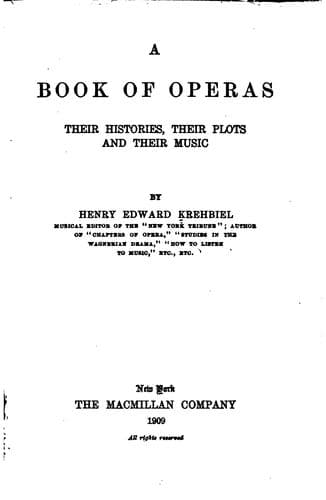
A Book of Operas: Their Histories, Their Plots, and Their MusicKrehbiel, Henry Edward
History
A Book of Operas: Their Histories, Their Plots, and Their Music
Krehbiel, Henry Edward
Operas -- Stories, plots, etc.
There are many Caves of Venus in Europe, but none around which
there clusters such a wealth of legend as around the grotto in the
Hörselberg. Nineteen years ago the writer of this book visited the
scene and explored the cave. He found it a decidedly commonplace
hole in the ground, but was richly rewarded by the results of
the literary explorations to which the visit led him. Before
Christianity came to reconstruct the folk-tales of the Thuringian
peasants, the Hörselberg was the home of Dame Holda, or Holle, and
the horde of weird creatures which used to go tearing through the
German forests on a wild rout in the Yuletide. Dame Holle, like many
another character in Teutonic mythology, was a benignant creature,
whose blessing brought forth fruitfulness to fields and vineyards,
before the Christian priests metamorphosed her into a thing wholly
of evil. She was the mother of all the fays and fairies that
followed in the train of the Wild Huntsman, and though she appeared
at times as a seductive siren and tempted men to their destruction,
she appeared oftener as an old woman who rewarded acts of kindness
with endless generosity. It was she who had in keeping the souls of
unborn children, and babes who died before they could be christened
were carried by her to the Jordan and baptized in its waters.
Even after priestly sermons had transformed her into a beauteous
she-devil, she still kept up her residence in the cave, which now,
in turn, took on a new character. Venturesome persons who got near
its mouth, either purposely or by accident, told of strange noises
which issued from it, like the rushing of many waters or the voice
of a subterranean storm. The priests supplied explanation and
etymology to fit the new state of things. The noise was the
lamentation of souls in the fires of purgatory, to which place of
torment the cave was an opening. This was said to account for
the old German name of the mountain--"Hör-Seel-Berg"--that is,
"Hear-Souls-Mountain." To this Latin writers added another, viz.
"Mons Horrisonus"--"the Mountain of Horrible Sounds." The forbidding
appearance of the exterior--in which some fantastic writers avowed
they saw a resemblance to a coffin--was no check on the fancy of
the mediaeval storyteller, however, who pictured the interior of
the mountain as a marvellous palace, and filled it with glittering
jewels and treasures incalculable. The story of Tannhäuser's sojourn
within this magical cavern is only one of many, nor do they all end
like that of the minstrel knight. Undeterred by the awful tales told
by monks and priests, poets and romancers sang the glories and the
pleasures of the cave as well as its gruesome punishments. From them
we know many things concerning the appearance of the interior, the
cave's inhabitants, and their merrymakings. I cannot resist the
temptation to retell one of these old tales.
Public-domain text, read in full here on John Shaqi.
Reviews
Reviews
No reviews yet
Be the first to share your thoughts on this work.
Elsewhere in the archive
Join the Discussion
Join the discussion
Sign in to leave a comment or review.
Sign InorCreate an account