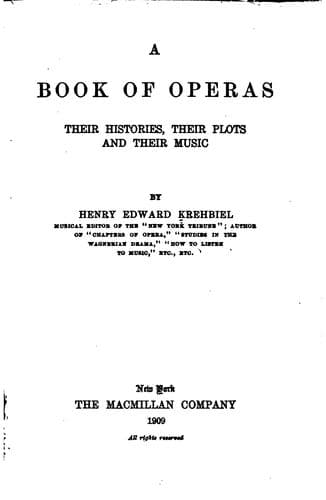
A Book of Operas: Their Histories, Their Plots, and Their MusicKrehbiel, Henry Edward
History
A Book of Operas: Their Histories, Their Plots, and Their Music
Krehbiel, Henry Edward
Operas -- Stories, plots, etc.
Students of comparative mythology and folklore will have no
difficulty in seeing in the legend of Tannhäuser one of the many
tales of the association during a period of enchantment of men and
elves. Parallels between the theatre and apparatus of these tales
extend back into remote antiquity. The grotto of Venus, in which
Tannhäuser steeps himself with sensuality, is but a German variant
of the Garden of Delight, in which the heroes of antiquity met their
fair enslavers. It is Ogygia, the Delightful Island, where Ulysses
met Calypso. It is that Avalon in which King Arthur was healed of
his wounds by his fairy sister Morgain. The crozier which bursts
into green in token of Tannhäuser's forgiveness has prototypes
in the lances which, when planted in the ground by Charlemagne's
warriors, were transformed overnight into a leafy forest; in the
javelins of Polydore, of which Virgil tells us in the "AEneid"; in
the staff of St. Christopher, which grew into a tree after he had
carried the Christ Child across the river; in the staff which put on
leaves in the hands of Joseph, wherefore the Virgin Mary gave him
her hand in marriage; in the rod of Aaron, which, when laid up among
others in the tabernacle, "brought forth buds and bloomed blossoms
and yielded almonds."
There are many parallels in classic story and folklore of the
incident of Tannhäuser's sojourn with Venus. I mention but a few.
There are the episodes of Ulysses and Calypso, Ulysses and Circe,
Numa and Egeria, Rinaldo and Armida, Prince Ahmed and Peri Banou.
Less familiar are the folk-tales which Mr. Baring-Gould has
collected of Helgi's life with the troll Ingibjorg, a Norse story;
of James Soideman of Serraade, "who was kept by the spirits in a
mountain during the space of seven years, and at length came out,
but lived afterwards in great distress and fear lest they should
again take him away"; of the young Swede lured away by an elfin
woman from the side of his bride into a mountain, where he abode
with the siren forty years and thought it but an hour.
Public-domain text, read in full here on John Shaqi.
Reviews
Reviews
No reviews yet
Be the first to share your thoughts on this work.
Elsewhere in the archive
Join the Discussion
Join the discussion
Sign in to leave a comment or review.
Sign InorCreate an account