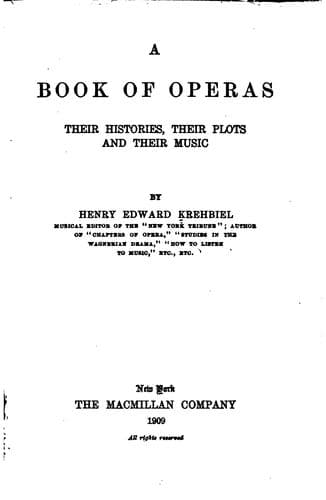
A Book of Operas: Their Histories, Their Plots, and Their MusicKrehbiel, Henry Edward
History
A Book of Operas: Their Histories, Their Plots, and Their Music
Krehbiel, Henry Edward
Operas -- Stories, plots, etc.
The thought of her humiliation maddens the high-spirited woman,
and she sends her maid, Brangäne, to summon the knight into her
presence. The knight parleys diplomatically with the messenger. Duty
keeps him at the helm, but once in port he will suffer no one but
himself to escort the exalted lady into the presence of the king. At
the last the maid is forced to deliver the command in the imperious
words used by her mistress. This touches the pride of Tristan's
squire, Kurwenal, who asks permission to frame an answer, and,
receiving it, shouts a ballad of his master's method of paying
tribute to Ireland with the head of his enemy; for the battle
between Tristan and Morold had grown out of the effort made by the
latter to collect tribute-money from England. It is a stiff stave,
rugged, forceful, and direct, in which the spirit of the political
ballad of all times is capitally preserved.
Isolde resolves to wipe out what she conceives to be her disgrace by
slaying Tristan and herself. Brangäne tries to persuade her that the
crown of Cornwall will bring her honor, and when Isolde answers
that it would be intolerable to live in the presence of Tristan and
not have his love, she hints that her mother had not sent her into
a strange land without providing for all contingencies. Isolde
understands the allusion to her mother's magical lore, and commands
that a casket be brought to her. Brangäne obeys with alacrity and
exhibits its contents: lotions for wounds, antidotes for poisons,
and, best of all,--she holds a phial aloft. Isolde will not have it
so; she herself had marked the phial whose contents were to remedy
her ills. "The death draught!" exclaims Brangäne, and immediately
the "Yo, heave ho!" of the sailors is heard and the shout of "Land!"
Throughout this scene a significant phrase is heard--the symbol
of death:--
[Musical excerpt]
Also the symbol of fate--a downward leap of a seventh, as in the
last two notes of the brief figure illustrative of the glance which
had inspired Isolde's fatal love.
Public-domain text, read in full here on John Shaqi.
Reviews
Reviews
No reviews yet
Be the first to share your thoughts on this work.
Elsewhere in the archive
Join the Discussion
Join the discussion
Sign in to leave a comment or review.
Sign InorCreate an account