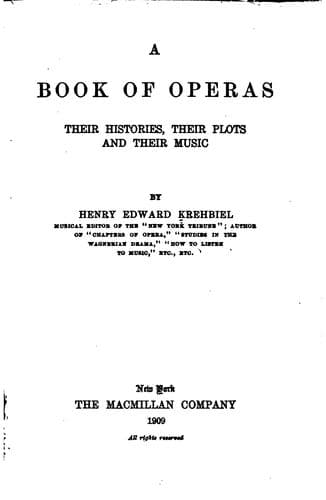
A Book of Operas: Their Histories, Their Plots, and Their MusicKrehbiel, Henry Edward
History
A Book of Operas: Their Histories, Their Plots, and Their Music
Krehbiel, Henry Edward
Operas -- Stories, plots, etc.
At sight of land Tristan leaves the helm and presents himself before
Isolde. She upbraids him for having avoided her during the voyage;
he replies that he had obeyed the commands of honor and custom. She
reminds him that a debt of blood is due her--he owes her revenge for
the death of Morold. Tristan offers her his sword and his breast;
but she declines to kill the best of all Marke's knights, and
offers to drink with him a cup of forgiveness. He divines her
purpose and takes the cup from her hand and gives this pledge:
Fidelity to his honor, defiance to anguish. To his heart's illusion,
his scarcely apprehended dream, will he drink the draught which
shall bring oblivion. Before he has emptied the cup, Isolde snatches
it from his hands and drains it to the bottom. Thus they meet
their doom, which is not death and surcease of sorrow, as both had
believed, but life and misery; for Brangäne, who had been commanded
to pour the poison in the cup, had followed an amiable prompting and
presented the love-potion instead. A moment of bewilderment, and
the fated ones are in each other's arms, pouring out an ecstasy of
passion. Then her maids robe Isolde to receive the king, who is
coming on board the ship to greet his bride.
In the introduction to the second act, based upon this restless
phrase,--
[Musical excerpt]
we have a picture of the longing and impatience of the lovers before
a meeting. When the curtains part, we discover a garden before the
chamber of Isolde, who is now Cornwall's queen. It is a lovely night
in summer. A torch burns in a ring beside the door opening into
the chamber at the top of a stone staircase. The king has gone
a-hunting, and the tones of the hunting-horns, dying away in the
distance, blend entrancingly with an instrumental song from the
orchestra which seems a musical sublimation of night and nature in
their tenderest moods. Isolde appears with Brangäne and pleads with
her to extinguish the torch and thus give the appointed signal to
Tristan, who is waiting in concealment. But Brangäne suspects
treachery on the part of Melot, a knight who is jealous of Tristan
and himself enamoured of Isolde. It was he who had planned the
nocturnal hunt. She warns her mistress, and begs her to wait. Beauty
rests upon the scene like a benediction. To Isolde the horns are but
the rustling of the forest leaves as they are caressed by the wind,
or the purling and laughing of the brook. Longing has eaten up all
patience, all discretion, all fear. In spite of Brangäne's pleadings
she extinguishes the torch, and with wildly waving scarf beckons on
her hurrying lover. Beneath the foliage they sing their love through
all the gamut of hope and despair, of bliss and wretchedness. The
duet consists largely of detached ejaculations and verbal plays,
each paraphrasing or varying or giving a new turn to the outpouring
of the other, the whole permeated with the symbolism of pessimistic
philosophy in which night, death, and oblivion are glorified, and
Public-domain text, read in full here on John Shaqi.
Reviews
Reviews
No reviews yet
Be the first to share your thoughts on this work.
Elsewhere in the archive
Join the Discussion
Join the discussion
Sign in to leave a comment or review.
Sign InorCreate an account