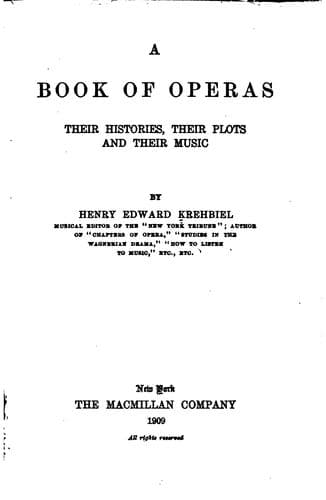
A Book of Operas: Their Histories, Their Plots, and Their MusicKrehbiel, Henry Edward
History
A Book of Operas: Their Histories, Their Plots, and Their Music
Krehbiel, Henry Edward
Operas -- Stories, plots, etc.
that the talismanic vessel is
the cup itself from which our Lord
Drank at the last sad supper with His own;
that the lance which struck and healed the grievous wound in the
side of the king is the spear with which the side of the Christ was
pierced on Calvary. It is also obvious that the king, whose name
is Amfortas, that is, "the powerless one," is a symbol of humanity
suffering from the wounds of slavery to desire; that the heroic act
of Parsifal, as Wagner calls him, which brings release to the king
and his knights, is renunciation of desire, prompted by pity,
compassion, fellow-suffering; and that this gentle emotion it was
that had inspired knowledge simultaneously of a great need and a
means of deliverance. The ethical idea of the drama, as I set forth
in a book entitled "Studies in the Wagnerian Drama" many years ago,
is that it is the enlightenment which comes through pity which
brings salvation. The allusion is to the redemption of mankind
by the sufferings and compassionate death of Christ; and that
stupendous tragedy is the prefiguration of the mimic drama which
Wagner has constructed. The spectacle to which he invites us, and
with which he hoped to impress us and move us to an acceptance of
the lesson underlying his play, is the adoration of the Holy Grail,
cast in the form of a mimicry of the Last Supper, bedizened with
some of the glittering pageantry of mediaeval knighthood and romance.
In the minds of many persons it is a profanation to make a stage
spectacle out of religious things; and it has been urged that
"Parsifal" is not only religious but specifically Christian; not
only Christian but filled with parodies of elements which are partly
liturgical, partly Biblical. In narrating the incidents of the play
I have purposely avoided all allusions to the things which have been
matters of controversy. It is possible to look upon "Parsifal" as a
sort of glorified fairy tale, and to this end I purpose to subject
its elements to inquiry, and shall therefore go a bit more into
detail. Throughout the play Parsifal is referred to as a redeemer,
and in the third act scenes in which he plays as the central figure
are borrowed from the life of Christ. Kundry, the sorceress, who
attempts his destruction at one time and is in the service of the
knights of the Grail at another, anoints his feet and dries them
with her hair, as the Magdalen did the feet of Christ in the house
of Simon the Pharisee. Parsifal baptizes Kundry and admonishes her
to believe in the Redeemer:--
Die Taufe nimm
Und glaub' an den Erlöser!
Public-domain text, read in full here on John Shaqi.
Reviews
Reviews
No reviews yet
Be the first to share your thoughts on this work.
Elsewhere in the archive
Join the Discussion
Join the discussion
Sign in to leave a comment or review.
Sign InorCreate an account