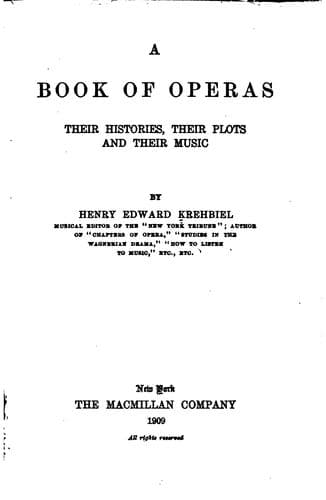
A Book of Operas: Their Histories, Their Plots, and Their MusicKrehbiel, Henry Edward
History
A Book of Operas: Their Histories, Their Plots, and Their Music
Krehbiel, Henry Edward
Operas -- Stories, plots, etc.
[Musical excerpt--"Komm, Komm, holder Knabe," THE SEDUCTIVE SONG OF
THE FLOWER MAIDENS]
But they fail of their purpose, as does also an unwilling siren whom
the magician invokes with powerful conjurations. It is Kundry, who
is half Magdalen, half wicked sorceress, a messenger in the service
of the pious knights, and as such hideous of aspect; a tool in the
hands of the magician, and as such supernaturally beautiful. It was
to her charms that the suffering king had yielded. To win the youth
she tells him the story of his mother's death and gives to him her
last message and--a kiss! At the touch of her impure lips a flood of
passion, hitherto unfelt, pours through the veins of the lad, and in
its surge comes understanding of the suffering and woe which he had
witnessed in the castle on the mountain. Also a sense of his own
remissness. Compassionate pity brings enlightenment; and he thrusts
back the woman who is seeking to destroy him. Finding that the wiles
of his tool have availed him naught, the wicked magician himself
appears to give battle, for he, too, knows the oracle and fears the
coming of the king's deliverer and the loss of the weapon which he
hopes will yet enable him to achieve the mystical talisman. He hurls
the lance at the youth, but it remains suspended in midair. The lad
seizes it, makes the sign of the cross, speaks some words of exorcism,
and garden, castle, damsels--all the works of enchantment disappear.
Now the young hero is conscious of a mission. He must find again
the abode of the knights and their ailing king, and bring to them
surcease of suffering. After long and grievous wanderings he is
again directed to the castle. Grief and despair have overwhelmed the
knights, whose king, unable longer to endure the torture in which he
has lived, has definitively refused to perform his holy office. In
consequence, his father, no longer the recipient of supernatural
sustenance, has died, and the king longs to follow him. The hero
touches the wound in the side of the king with the sacred spear,
ends his dolors, and is hailed as king in his place. The temptress,
who has followed him as a penitent, freed from a curse which had
rested upon her for ages, goes to a blissful and eternal rest.
* * *
Such is the story of Wagner's "Parsifal." It is the purpose of this
book to help the musical layman who loves lyric drama to enjoyment.
Criticism might do this, but a purpose of simple exposition has
already been proclaimed, and shall be adhered to lest some reader
think that he is being led too far afield. In this case the
exposition shall take the form of a marshalling of the elements of
the story in two aspects--religious and legendary. Careful readers
of English literature will have had no difficulty in recognizing in
it a story of the quest of the Holy Grail. Tennyson will have taught
them that the hero is that
Sir Percivale
Whom Arthur and his knighthood called the Pure;
Public-domain text, read in full here on John Shaqi.
Reviews
Reviews
No reviews yet
Be the first to share your thoughts on this work.
Elsewhere in the archive
Join the Discussion
Join the discussion
Sign in to leave a comment or review.
Sign InorCreate an account