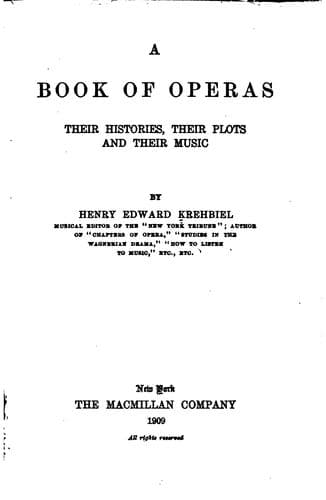
A Book of Operas: Their Histories, Their Plots, and Their MusicKrehbiel, Henry Edward
History
A Book of Operas: Their Histories, Their Plots, and Their Music
Krehbiel, Henry Edward
Operas -- Stories, plots, etc.
Nevertheless, it does not necessarily follow that Wagner wished only
to parody the eucharistic rite. He wanted to create a ceremonial
which should be beautiful, solemn, and moving; which should be an
appropriate accompaniment to the adoration of a mystical relic;
which should, in a large sense, be neither Catholic, Protestant,
nor Buddhistic; which should symbolize a conception of atonement
older than Christianity, older than Buddhism, older than all records
of the human imagination. Of this more anon. As was his custom,
Wagner drew from whatever source seemed to him good and fruitful;
and though he doubtless thought himself at liberty to receive
suggestions from the Roman Catholic ritual, as well as the German
Lutheran, it is even possible that he had also before his mind
scenes from Christian Masonry. This possibility was once suggested
by Mr. F. C. Burnand, who took the idea from the last scene of the
first act only, and does not seem to have known how many connections
the Grail legend had with mediaeval Freemasonry or Templarism. There
are more elements associated with the old Knights Templars and their
rites in Wagner's drama than I am able to discuss. To do so I should
have to be an initiate and have more space at my disposal than I
have here. I can only make a few suggestions: In the old Welsh tale
of Peredur, which is a tale of the quest of a magical talisman, the
substitute for the grail is a dish containing a bloody head. That
head in time, as the legend passed through the imaginations of poets
and romances, became the head of John the Baptist, and there was a
belief in the Middle Ages that the Knights Templars worshipped a
bloody head. The head of John the Baptist enters dimly into Wagner's
drama in the conceit that Kundry is a reincarnation of Herodias,
who is doomed to make atonement, not for having danced the head off
the prophet's shoulders, but for having reviled Christ as he was
staggering up Calvary under the load of the cross. But this is
pursuing speculations into regions that are shadowy and vague. Let
it suffice for this branch of our study that Mr. Burnand has given
expression to the theory that the scene of the adoration of the
grail and the Love Feast may also have a relationship with the
ceremony of installation in the Masonic orders of chivalry, in
which a cup of brotherly love is presented to the Grand Commander,
who drinks and asks the Sir Knights to pledge him in the cup "in
commemoration of the Last Supper of our Grand Heavenly Captain, with
his twelve disciples, whom he commanded thus to remember him." Here,
says Mr. Burnand, there is no pretence to sacrifice. Participation
in the wine is a symbol of a particular and peculiarly close
intercommunion of brotherhood.
Public-domain text, read in full here on John Shaqi.
Reviews
Reviews
No reviews yet
Be the first to share your thoughts on this work.
Elsewhere in the archive
Join the Discussion
Join the discussion
Sign in to leave a comment or review.
Sign InorCreate an account