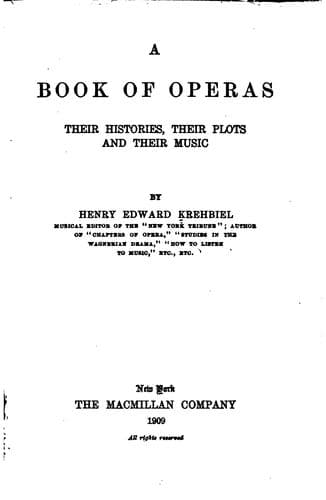
A Book of Operas: Their Histories, Their Plots, and Their MusicKrehbiel, Henry Edward
History
A Book of Operas: Their Histories, Their Plots, and Their Music
Krehbiel, Henry Edward
Operas -- Stories, plots, etc.
To get the least offence from "Parsifal" it ought to be accepted in
the spirit of the time in which Christian symbolism was grafted on
the old tales of the quest of a talisman which lie at the bottom of
it. The time was the last quarter of the twelfth century and the
first quarter of the thirteenth. It is the period of the third
and fourth crusades. Relic worship was at its height. Less than a
hundred years before (in 1101) the Genoese crusaders had brought
back from the Holy Land as a part of the spoils of Caesarea, which
they were helpful in capturing under Baldwin, a three-cornered dish,
which was said to be the veritable dish used at the Last Supper of
Christ and his Apostles. The belief that it was cut out of a solid
emerald drew Bonaparte's attention to it, and he carried it away
to Paris in 1806 and had it examined. It proved to be nothing but
glass, and he graciously gave it back to Genoa in 1814. There it
still reposes in the Church of St. John, but it is no longer an
object of worship, though it might fairly excite a feeling of
veneration.
For 372 years Nuremberg possessed what the devout believed to be the
lance of Longinus, with which the side of Christ was opened. The
relic, like most objects of its kind (the holy coat, for instance),
had a rival which, after inspiring victory at the siege of Antioch,
found its way to Paris with the most sacred relics, for which Louis
IX built the lovely Sainte Chapelle; now it is in the basilica of
the Vatican, at Rome. The Nuremberg relic, however, enjoyed the
advantage of historical priority. It is doubly interesting, or
rather was so, because it was one of Wagner's historical characters
who added it to the imperial treasure of the Holy Roman Empire. This
was none other than Henry the Fowler, the king who is righteous in
judgment and tuneful of speech in the opera "Lohengrin." Henry, so
runs the story, wrested the lance from the Burgundian king, Rudolph
III, some time about A.D. 929. After many vicissitudes the relic was
given for safe keeping to the imperial city of Nuremberg, in 1424,
by the Emperor Sigismund. It was placed in a casket, which was
fastened with heavy chains to the walls of the Spitalkirche. There
it remained until 1796. One may read about the ceremonies attending
its annual exposition, along with other relics, in the old history
of Nuremberg, by Wagenseil, which was the source of Wagner's
knowledge of the mastersingers. The disruption of the Holy Roman
Empire caused a scattering of the jewels and relics in the imperial
treasury, and the present whereabouts of this sacred lance is
unknown. The casket and chains, however, are preserved in the
Germanic Museum at Nuremberg to this day, and there have been seen,
doubtless, by many who are reading these lines.
Public-domain text, read in full here on John Shaqi.
Reviews
Reviews
No reviews yet
Be the first to share your thoughts on this work.
Elsewhere in the archive
Join the Discussion
Join the discussion
Sign in to leave a comment or review.
Sign InorCreate an account