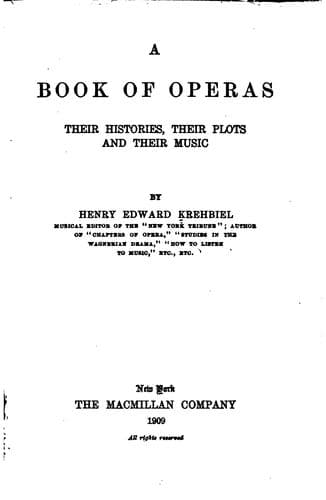
A Book of Operas: Their Histories, Their Plots, and Their MusicKrehbiel, Henry Edward
History
A Book of Operas: Their Histories, Their Plots, and Their Music
Krehbiel, Henry Edward
Operas -- Stories, plots, etc.
her intentions to Eva, whose departure with the knight had been
interrupted by the cobbler when he came out of his shop to work
in the cool of the evening; but he finally agrees to listen to
Beckmesser on condition that he be permitted to mark each error in
the composition by striking his lap-stone. The humorous consequences
can be imagined. Beckmesser becomes enraged at Sachs, sings more
and more falsely, until Sachs is occupied in beating a veritable
tattoo on his lap-stone. To add to Beckmesser's discomfiture,
David, Sachs's apprentice and Magdalena's sweetheart, thinking
the serenade intended for his love, begins to belabor the singer
with a chub; neighbors join in the brawl, which proceeds right
merrily until interrupted by the horn of a night watchman. The
dignity and vigor of Wagner's poetical fancy are attested by the
marvellous chose of the act. The tremendous hubbub of the street
brawl is at its height and the business of the act is at an end.
The coming of the Watchman, who has evidently been aroused by the
noise, is foretold by his horn. The crowd is seized with a panic.
All the brawlers disappear behind doors. The sleepy Watchman stares
about him in amazement, rubs his eyes, sings the monotonous chant
which publishes the hour of the night, continues on his round, and
the moon shines on a quiet street in Nuremberg as the curtain falls.
In the third act Walther, who had been taken into his house by Sachs
and spent the night there, sings a recital of a dream; and Sachs,
struck by its beauty, transcribes it, punctuating it with bits of
comments and advice. Beckmesser, entering Sachs's shop when the
cobbler-poet is out for a moment, finds the song, concludes that it
is Sachs's own composition, and appropriates it. Sachs, discovering
the theft, gives the song to Beckmesser, who secures a promise from
Sachs not to betray him, and resolves to sing it at the competition.
The festival is celebrated in a meadow on the banks of the Pegnitz
River, between Fürth and Nuremberg. It begins with a gathering
of all the guilds of Nuremberg, each division in the procession
entering to characteristic music--a real masterpiece, whether
viewed as spectacle, poetry, or music. The competition begins, and
Beckmesser makes a monstrously stupid parody of Walther's song.
He is hooted at and ridiculed, and, becoming enraged, charges the
authorship of the song on Sachs, who coolly retorts that it is
a good song when correctly sung. To prove his words he calls on
Walther to sing it. The knight complies, the mastersingers are
delighted, and Pogner rewards the singer with Eva's hand. Sachs,
at the request of the presiding officer of the guild, also offers
him the medal as the insignia of membership in the guild of
mastersingers. Walther's experience with the pedantry which had
condemned him the day before, when he had sung as impulse, love, and
youthful ardor had prompted, leads him to decline the distinction;
Public-domain text, read in full here on John Shaqi.
Reviews
Reviews
No reviews yet
Be the first to share your thoughts on this work.
Elsewhere in the archive
Join the Discussion
Join the discussion
Sign in to leave a comment or review.
Sign InorCreate an account