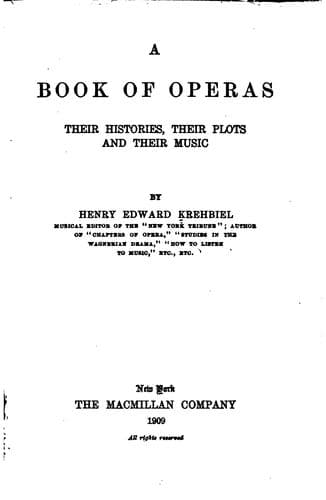
A Book of Operas: Their Histories, Their Plots, and Their MusicKrehbiel, Henry Edward
History
A Book of Operas: Their Histories, Their Plots, and Their Music
Krehbiel, Henry Edward
Operas -- Stories, plots, etc.
As a picture of the social life of a quaint German city three and a
half centuries ago, its vividness and truthfulness are beyond all
praise; it is worthy to stand beside the best dramas of the world,
and has no equal in operatic literature. The food for its satire,
too, is most admirably chosen, for no feature of the social life of
that place and period is more amiably absurd than the efforts of the
handicraftsmen and tradespeople, with their prosaic surroundings,
to keep alive by dint of pedantic formularies the spirit of
minstrelsy, which had a natural stimulus in the chivalric life of
the troubadours and minnesingers of whom the mastersingers thought
themselves the direct and legitimate successors. In its delineation
of the pompous doings of the mastersingers, Wagner is true to
the letter. He has vitalized the dry record to be found in old
Wagenseil's book on Nuremberg, {1} and intensified the vivid
description of a mastersingers' meeting which the curious may read
in August Hagen's novel "Norica." His studies have been marvellously
exact and careful, and he has put Wagenseil's book under literal and
liberal contribution, as will appear after a while. Now it seems
best to tell the story of the comedy before discussing it further.
Veit Pogner, a rich silversmith, desiring to honor the craft of the
mastersingers, to whose guild he belongs, offers his daughter Eva
in marriage to the successful competitor at the annual meeting of
the mastersingers on the feast of St. John. Eva is in love (she
declares it in the impetuous manner peculiar to Wagner's heroines)
with Walther von Stolzing, a young Franconian knight; and the knight
with her. After a flirtation in church during divine service,
Walther meets her before she leaves the building, and asks if she
be betrothed. She answers in the affirmative, but it is to the
unknown victor at the contest of singing on the morrow. He resolves
to enter the guild so as to be qualified for the competition. A
trial of candidates takes place in the church of St. Catherine in
the afternoon, and Walther, knowing nothing of the rules of the
mastersingers, some of which have hurriedly been outlined to him
by David, a youngster who is an apprentice at shoemaking and also
songmaking, fails, though Hans Sachs, a master in both crafts,
recognizes evidences of genius in the knight's song, and espouses
his cause as against Beckmesser, the town clerk, who aims at
acquiring Pogner's fortune by winning his daughter. The young
people, in despair at Walther's failure, are about to elope when
they are prevented by the arrival on the scene of Beckmesser. It is
night, and he wishes to serenade Eva; Sachs sits cobbling at his
bench, while Eva's nurse, Magdalena, disguised, sits at a window
to hear the serenade in her mistress's stead. Sachs interrupts
the serenader, who is an ill-natured clown, by lustily shouting
a song in which he seeks also to give warning of knowledge of
Public-domain text, read in full here on John Shaqi.
Reviews
Reviews
No reviews yet
Be the first to share your thoughts on this work.
Elsewhere in the archive
Join the Discussion
Join the discussion
Sign in to leave a comment or review.
Sign InorCreate an account