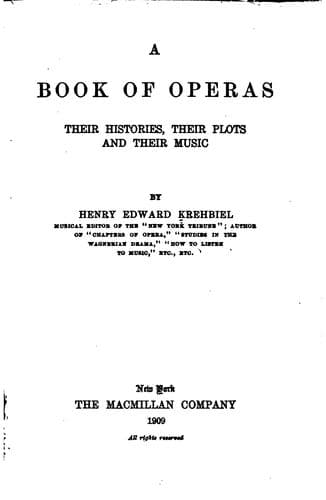
A Book of Operas: Their Histories, Their Plots, and Their MusicKrehbiel, Henry Edward
History
A Book of Operas: Their Histories, Their Plots, and Their Music
Krehbiel, Henry Edward
Operas -- Stories, plots, etc.
which opens the prelude, it is a strong, simple melody, made on the
intervals of the diatonic scale, square-cut in rhythm, firm and
dignified, and, like the mastersingers, complacent and a trifle
pompous in stride. The three melodies which are presented in
opposition to the spirit represented by the mastersingers and their
typical music, are disclosed by a study of the comedy to be
associated with the passion of the young lovers, Walther and Eva.
They differ in every respect--melodic, rhythmic, and harmonic,--from
those which stand for the old guildsmen and their rule-of-thumb
notions. They are chromatic, as see this:--
[Musical excerpt]
and this (which is the melody which in a broadened form becomes that
of Walther's prize song):--
[Musical excerpt]
and this, which is peculiarly the symbol of youthful ardor:--
[Musical excerpt]
Their rhythms are less regular and more eager (note the influence of
syncopation upon them); they are harmonized with greater warmth and
infused with greater passion. In the development of the prelude
these melodies are presented at first consecutively, then as in
conflict (first one, then another pushing forward for expression),
finally in harmonious and contented union. The middle part of the
prelude, in which the opening march tune is heard in short, quick
notes (in diminution, as the theoreticians say) maybe looked upon as
caricaturing the mastersingers, not in their fair estate, but as
they are satirized in the comedy in the person of Beckmesser.
Footnotes:
{1} "Joh. Christophori Wagenseilii De Sacri Rom. Imperii Libera
Civitate Noribergensi Commentatio. Accedit, De Germaniae
Phonascorum Von Der Meister-Singer Origine, Praestantia, Utilitate,
et Institutis, Sermone Vernaculo Liber. Altdorf Noricorum Typis
Impensisque Jodoci Wilhelmi Kohlesii. CID ICD XCVII."
{2} I quote from Wagenseil's book--he is writing about the history
of the mastersingers: "Nach der Stadt Mäyntz, hat in den Stätten
Nürnberg und Strassburg / die Meister-Singer-Kunst sonderlich
floriret / wie dann auchXII. Alte Nürnbergische Meister annoch im
Beruff sind; so mit Namen geheissen / 1. Veit Pogner. 2. Cuntz
Vogelgesang. 3. Hermann Ortel. 4. Conrad Nachtigal. 5. Fritz
Zorn. 6. Sixtus Beckmesser. 7. Fritz Kohtner. 8. Niclaus Vogel.
9. Augustin Moser. 10. Hannss Schwartz. 11. Ulrich Eisslinger.
12. Hannss Foltz."
Public-domain text, read in full here on John Shaqi.
Reviews
Reviews
No reviews yet
Be the first to share your thoughts on this work.
Elsewhere in the archive
Join the Discussion
Join the discussion
Sign in to leave a comment or review.
Sign InorCreate an account