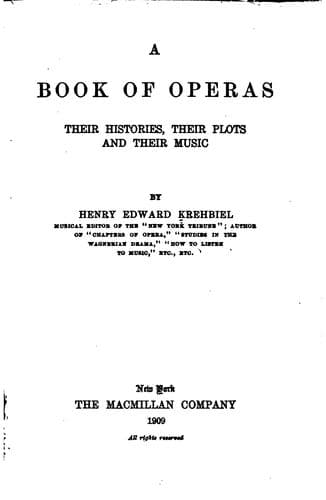
A Book of Operas: Their Histories, Their Plots, and Their MusicKrehbiel, Henry Edward
History
A Book of Operas: Their Histories, Their Plots, and Their Music
Krehbiel, Henry Edward
Operas -- Stories, plots, etc.
{3} "In the musical contest it is only the perverted idea of
Classicism which is treated with contumely and routed; the
glorification of the triumph of Romanticism is found in the
stupendously pompous and brilliant setting given to the
mastersingers' music at the end. You see already in this prelude
that Wagner is a true comedian. He administers chastisement with a
smile and chooses for its subject only things which are temporary
aberrations from the good. What is strong, and true, and pure, and
wholesome in the art of the mastersingers he permits to pass through
his satirical fires unscathed. Classicism, in its original sense as
the conservator of that which is highest and best in art, he leaves
unharmed, presenting her after her trial, as Tennyson presents his
Princess at the close of his corrective poem, when
"All
Her falser self slipt from her like a robe,
And left her woman, lovelier in her mood
Than in her mould that other, when she came
From barren deeps to conquer all with love."
--"Studies in the Wagnerian Drama," by H. E. Krehbiel, p. 95.
CHAPTER XVI
"LOHENGRIN"
In the last hundred lines of the last book of his epic poem to which
Wagner went for the fundamental incidents, not principles, of his
"Parsifal," Wolfram von Eschenbach tells the story of one of the
Grail King's sons whom he calls Loherangrin. This son was a lad when
Parzival (thus Wolfram spells the name) became King of the Holy
Grail and the knights who were in its service. When he had grown
to manhood, there lived in Brabant a queen who was equally gifted
in beauty, wealth, and gentleness. Many princes sought her hand in
marriage, but she refused them all, and waited for the coming of one
whom God had disclosed to her in a vision. One day a knight of great
beauty and nobley, as Sir Thomas Mallory would have said, came to
Antwerp in a boat drawn by a swan. To him the queen at once gave
greeting as lord of her dominions; but in the presence of the
assembled folk he said to her: "If I am to become ruler of this
land, know that it will be at great sacrifice to myself. Should you
nevertheless wish me to remain with you, you must never ask who
I am; otherwise I must leave you forever." The queen made solemn
protestation that she would never do aught against his will. Then
her marriage with the stranger knight was celebrated, and they abode
together long in happiness and honor. But at the last the queen was
led to put the fatal question. Then the swan appeared with the boat,
and Loherangrin, for it was he, was drawn back to Montsalvat, whence
he had come. But to those whom he left behind he gave his sword,
horn, and ring.
Public-domain text, read in full here on John Shaqi.
Reviews
Reviews
No reviews yet
Be the first to share your thoughts on this work.
Elsewhere in the archive
Join the Discussion
Join the discussion
Sign in to leave a comment or review.
Sign InorCreate an account