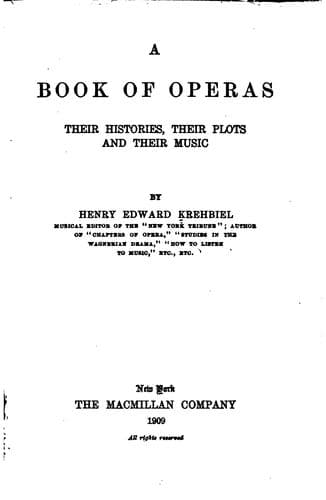
A Book of Operas: Their Histories, Their Plots, and Their MusicKrehbiel, Henry Edward
History
A Book of Operas: Their Histories, Their Plots, and Their Music
Krehbiel, Henry Edward
Operas -- Stories, plots, etc.
There are other mediaeval poems which deal with the story of
Lohengrin, more, indeed, than can or need be discussed here. Some,
however, deserve consideration because they supply elements which
Wagner used in his opera but did not find in Wolfram's poem. Wagner
went, very naturally, to a poem of the thirteenth century, entitled
"Lohengrin," for the majority of the incidents of the drama. Thence
he may have drawn the motive for the curiosity of Elsa touching the
personality of her husband. Of course, it lies in human nature, as
stories which are hundreds if not thousands of years older attest;
but I am trying, as I have been in preceding chapters in this book,
to account for the presence of certain important elements in
Wagner's opera, and so this poem must also be considered. In it
Lohengrin rescues Elsa, the Duchess of Brabant, from the false
accusations of Telramund, the knight having been summoned from
Montsalvat (or "Monsalväsch," to be accurate) by the ringing of a
bell which Elsa had taken from a falcon's leg. The knight marries
her, but first exacts a promise that she will never seek of him
knowledge of his race or country. After the happy domestic life of
the pair has been described, it is told how Lohengrin overthrew the
Duke of Cleves at a tournament in Cologne and broke his arm. The
Duchess of Cleves felt humiliated at the overthrow of her husband by
a knight of whom nothing was known, and wickedly insinuated that it
was a pity that so puissant a jouster should not be of noble birth,
thereby instilling a fatal curiosity into the mind of the Lady of
Brabant, which led to questions which Lohengrin answered before the
emperor's court and then disappeared from view. From "Der jüngere
Titurel," another mediaeval poem, came the suggestion that the
mysterious knight's prowess was due to sorcery and might be set at
naught if his bodily integrity were destroyed even in the slightest
degree. In the French tale of "Le Chevalier au Cygne," as told in
the "Chansons de geste," you may read the story of Helyas, who was
one of seven children of King Oriant and Queen Beatrix, who were
born with silver chains around their necks. The chains being removed
with evil purpose, the children turned into swans and flew away--all
but one, Helyas, who was absent at the time. But Helyas got
possession of all the chains but one, which had been wrought into a
cup, and one day, when he heard the sound of wings, and six swans
let themselves down into the water, he threw the chains around their
necks, and they at once assumed the forms of his brothers. Also how,
one day, Helyas, from the window of his palace, saw a swan drawing a
boat, and how he donned his armor, took a golden horn, and was drawn
away to Nimwegen, where Emperor Otto was holding court. There he
found that the Count of Blankenbourg had accused his sister-in-law,
the Duchess of Bouillon, of having poisoned her husband, and had
laid claim to the duchy. There was to be a trial by ordeal of
Public-domain text, read in full here on John Shaqi.
Reviews
Reviews
No reviews yet
Be the first to share your thoughts on this work.
Elsewhere in the archive
Join the Discussion
Join the discussion
Sign in to leave a comment or review.
Sign InorCreate an account