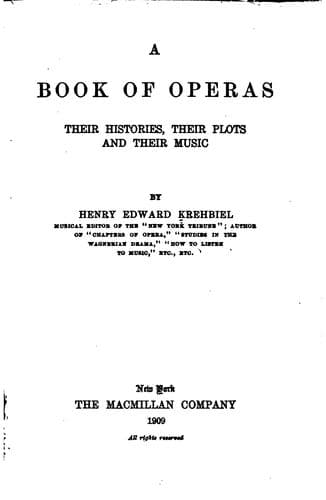
A Book of Operas: Their Histories, Their Plots, and Their MusicKrehbiel, Henry Edward
History
A Book of Operas: Their Histories, Their Plots, and Their Music
Krehbiel, Henry Edward
Operas -- Stories, plots, etc.
In this story of Lohengrin there is an admixture of several elements
which once had no association. It is the story of an adventure of a
Knight of the Holy Grail; also a story involving the old principle
of taboo; and one of many stories of the transformation of a human
being into a swan, or a swan into a human being. This swan myth is
one of the most widely spread of all transformation tales; it may
even be found in the folk-stories of the American Indians. To
discuss this feature would carry one too far afield, and I have
a different purpose in view.
* * *
The two Figaro operas, the discussion of which opened this book,
were composed by different men, and a generation of time separated
their production. The opera which deals with the second chapter of
the adventures of Seville's factotum was composed first, and is the
greater work of the two; yet we have seen how pleasantly they can be
associated with each other, and, no doubt, many who admire them have
felt with me the wish that some musician with sufficient skill and
the needful reverence would try the experiment of remodelling the
two and knitting their bonds closer by giving identity of voice
to the personages who figure in both. The Wagnerian list presents
something like a parallel, and it would be a pleasant thing if two
of the modern poet-composer's dramas which have community of subject
could be brought into similar association, so that one might be
performed as a sequel to the other. The operas are "Lohengrin" and
"Parsifal." A generation also lies between them, and they ought
to bear a relationship to each other something like that existing
between "Le Nozze di Figaro" and "Il Barbiere di Siviglia." Indeed,
the bond ought to be closer, for one man wrote books and music
as well of the Grail dramas, whereas different librettists and
different composers created the Figaro comedies. But it will
never be possible to bring Wagner's most popular opera and his
"stage-consecrating play" into logical union, notwithstanding that
both deal with the legend of the Holy Grail and that the hero of one
proclaims himself to be the son of the hero of the other. Wagner
cast a loving glance at the older child of his brain when he quoted
some of the "swan music" of "Lohengrin "in "Parsifal"; but he built
an insurmountable wall between them when he forsook the sane and
simple ideas which inspired him in writing "Lohengrin" for the
complicated fabric of mediaeval Christianity and Buddhism which
he strove to set forth in "Parsifal." In 1847 Wagner was willing
to look at the hero of the quest of the Holy Grail whom we
call Percival through the eyes of his later guide, Wolfram von
Eschenbach. To Wolfram Parzival was a married man; more than that--a
married lover, clinging with devotion to the memory of the wife from
whose arms he had torn himself to undertake the quest, and losing
himself in tender brooding for days when the sight of blood-spots
Public-domain text, read in full here on John Shaqi.
Reviews
Reviews
No reviews yet
Be the first to share your thoughts on this work.
Elsewhere in the archive
Join the Discussion
Join the discussion
Sign in to leave a comment or review.
Sign InorCreate an account