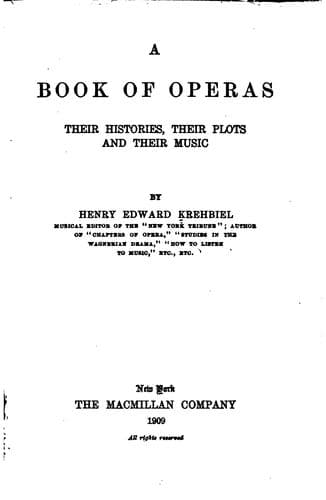
A Book of Operas: Their Histories, Their Plots, and Their MusicKrehbiel, Henry Edward
History
A Book of Operas: Their Histories, Their Plots, and Their Music
Krehbiel, Henry Edward
Operas -- Stories, plots, etc.
on the snow suggested to his fancy the red and white of fair
Konwiramur's cheeks. Thirty years later Wagner could only conceive
of his Grail hero as a celibate and an ascetic. Lohengrin glories in
the fact that he is the son of him who wears the crown of the Grail;
but Parsifal disowns his son.
This is one instance of the incoherency of the two Grail dramas.
There is another, and by this second departure from the old legends
which furnished forth his subject, Wagner made "Lohengrin" and
"Parsifal" forever irreconcilable. The whole fabric of the older
opera rests on the forbidden question:--
Nie solist du mich befragen, noch
Wissen's Sorge tragen,
woher ich kam der Fahrt,
noch wie mein Nam' und Art. {2}
So impressed was Wagner with the significance of this dramatic
motive sixty years ago, that he gave it a musical setting which
still stands as the finest of all his many illustrations of the
principle of fundamental or typical phrases in dramatic music:--
[Musical excerpt--"Nie sollst du mich befragen"]
And no wonder. No matter where he turned in his studies of the
Grail legend, he was confronted by the fact that it was by asking a
question that the seeker after the Grail was to release the ailing
king, whom he found in the castle in which the talismans were
preserved, from his sufferings. In the Welsh tale of Peredur and
the French romances the question went only to the meaning of the
talismans; but this did not suffice Wolfram von Eschenbach, who
in many ways raised the ethical standard of the Grail legend. He
changed the question so as to make it a sign of affectionate and
compassionate interest on the part of the questioner; it was no
longer, "What mean the bloody head and the bleeding lance?" but
"What ails thee, uncle?"
Wagner was fond, a little overfond, indeed, of appealing to the
public over the heads of the critics, of going to the jury rather
than the judge, when asking for appreciation of his dramas; but
nothing is plainer to the close student than that he was never
wholly willing to credit the public with possession of that high
imaginativeness to which his dramas more than those of any other
composer make appeal. His first conception of the finale of
"Tannhäuser," for instance, was beautiful, poetical, and reasonable;
for the sake of a spectacle he reconstructed it after the original
production and plunged it into indefensible confusion and absurdity.
Public-domain text, read in full here on John Shaqi.
Reviews
Reviews
No reviews yet
Be the first to share your thoughts on this work.
Elsewhere in the archive
Join the Discussion
Join the discussion
Sign in to leave a comment or review.
Sign InorCreate an account