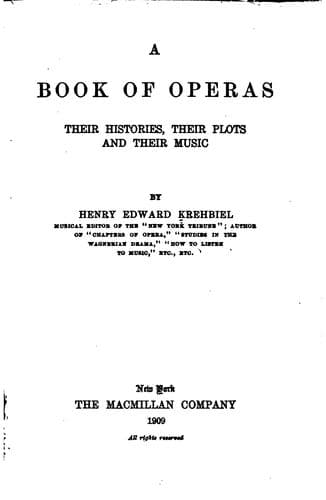
A Book of Operas: Their Histories, Their Plots, and Their MusicKrehbiel, Henry Edward
History
A Book of Operas: Their Histories, Their Plots, and Their Music
Krehbiel, Henry Edward
Operas -- Stories, plots, etc.
It was Wagner who created the contradiction which puts his operas
in opposition by his substitution of the sacred lance as a dramatic
motive for the question. But poets had long before taken the
privilege of juggling with two elements of ancient myths and
folk-tales which are blended in the story of Lohengrin. Originally
there was no relationship between the Knight of the Holy Grail and
the Swan Knight, and there is no telling when the fusion of the
tales was made. But the element of the forbidden question is of
unspeakable antiquity and survives in the law of taboo which
exists among savages to-day. When Wagner discussed his opera in
his "Communication to My Friends" he pointed out the resemblance
between the story of Lohengrin and the myth of Zeus and Semele. Its
philosophical essence he proclaimed to be humanity's feeling of
the necessity of love. Elsa was "the woman who drew Lohengrin from
the sunny heights to the depths of earth's warm heart. . . . Thus
yearned he for woman--for the human heart. And thus did he step down
from out his loneliness of sterile bliss when he heard this woman's
cry for succor, this heart cry from humanity below." This is all
very well, and it would be churlish to say that it is not beautifully
reflected in Wagner's drama; but it does not explain the need of the
prohibition. A woman who loves must have unquestioning faith in her
husband--that is all. But there are two ancient myths which show
that the taboo was conceived as a necessary ingredient of the
association of divine men with human women. Let both be recalled,
for both have plainly gone over into the mediaeval story.
The first is the one to which Wagner made allusion: Jupiter has
given his love to Semele. Wickedly prompted by the jealous Juno,
Semele asks her august lover to grant her a wish. He promises
that she shall have her desire, and confirms his words with the
irrevocable oath, swearing by the Stygian flood. Semele asks him
then to appear to her in all his celestial splendor. The god would
have stopped her when he realized her purpose, but it was too late.
Sorrowfully he returned to the celestial abode and fearfully he put
on his lesser panoply. Arrayed in this he entered the chamber of
Semele, but though he had left behind him the greater splendors,
the immortal radiance consumed her to ashes.
Public-domain text, read in full here on John Shaqi.
Reviews
Reviews
No reviews yet
Be the first to share your thoughts on this work.
Elsewhere in the archive
Join the Discussion
Join the discussion
Sign in to leave a comment or review.
Sign InorCreate an account