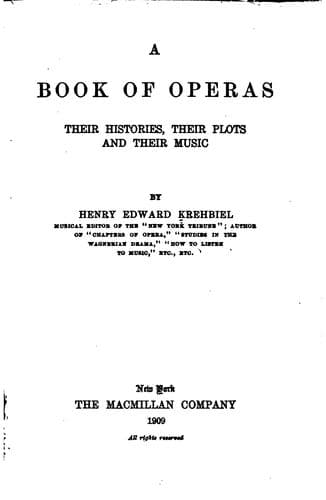
A Book of Operas: Their Histories, Their Plots, and Their MusicKrehbiel, Henry Edward
History
A Book of Operas: Their Histories, Their Plots, and Their Music
Krehbiel, Henry Edward
Operas -- Stories, plots, etc.
Weil der gute Amfortas
So lang in bittern Schmerzen lag,
Und ihn die Frage lange mied,
Ist ihnen alles Fragen leid;
All des Grales Dienstgesellen
Wollen sich nicht mehr fragen lassen.
The same explanation is made in the mediaeval poem "Lohengrin." We
are not called upon to admire the logic of Wolfram and the Knights
of the Grail, but nothing could be plainer than this: The sufferings
of Amfortas having been wofully prolonged by Parzival's failure to
ask the healing question, the Knights of the Grail were thereafter
required by their oracular guide to prohibit all questioning of
themselves under penalty of forfeiture of their puissant help.
When Wagner wrote his last drama, he was presented with a dilemma:
should he remain consistent and adhere to the question as a dramatic
motive, or dare the charge of inconsistency for the sake of that bit
of spectacular apparatus, the sacred lance? He chose inconsistency
and the show, and emphasized the element of relic worship to such
a degree as to make his drama foreign to the intellectual and
religious habits of the time in which he wrote. But this did not
disturb him; for he knew that beauty addresses itself to the
emotions rather than the intellect, and that his philosophical
message of the redeeming power of loving comnpassion would find
entrance to the hearts of the people over all the obstacles that
reason might interpose. Yet he destroyed all the poetical bonds
which ought or might have existed between "Parsifal" and "Lohengrin."
Public-domain text, read in full here on John Shaqi.
Reviews
Reviews
No reviews yet
Be the first to share your thoughts on this work.
Elsewhere in the archive
Join the Discussion
Join the discussion
Sign in to leave a comment or review.
Sign InorCreate an account