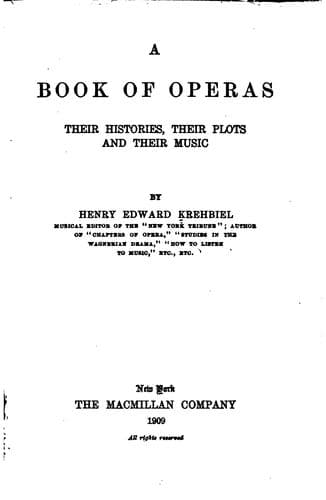
A Book of Operas: Their Histories, Their Plots, and Their MusicKrehbiel, Henry Edward
History
A Book of Operas: Their Histories, Their Plots, and Their Music
Krehbiel, Henry Edward
Operas -- Stories, plots, etc.
It is necessary, because the music is so beautiful and also because
the piece, like the "Leonore" overtures of Beethoven and the
"Meistersinger" prelude of Wagner (of which, indeed, it is a pretty
frank imitation) is a sort of epitome of the play, to spend some
time with the prelude to "Hänsel und Gretel." After I have done
this I shall say what I have to say about the typical phrases of
the score as they are reached, and shall leave to the reader the
agreeable labor of discovering the logical scheme underlying their
introduction and development. The prelude is built out of a few
themes which are associated with some of the most significant
elements of the play. Not one of them is a personal label, as is
widely, but erroneously, supposed to be the case in Wagner's dramas.
They stand for dramatic ideas and agencies, and when these are
passed in review, as it is purposed shall be done presently, it will
be found that not the sinister but the amiable features of the story
have been chosen for celebration in the overture. Here, too, in what
may be called the ethical meaning of the prelude, Humperdinck has
followed the example of Wagner in the prelude to his comedy. Simply
for the sake of identification hereafter names will be attached to
the themes out of which the prelude is constructed and which come
from the chief melodic factors of the opera. The most important of
these is the melody sung by the horns at the beginning:--
[Musical excerpt]
Let it be called the "Prayer Theme," for the melody is that of the
prayer which the little ones utter before laying themselves down to
sleep in the wood. The melody seems to be associated throughout the
opera with the idea of divine guardianship, and is first heard in
the first scene, when Hänsel, having complained of hunger, Gretel
gently chides him and holds out comfort in the words (here I use
the English version of the opera):--
When past bearing is our grief
God, the Lord, will send relief.
Humperdinck's splendid contrapuntal skill shows itself in a most
varied use of this theme. Once in the prelude it appears in three
different forms simultaneously, and in an augmented shape it forms
the substratum of the prelude, while other themes are cunningly
woven above it. The second theme is an exceedingly bright and
energetic little phrase with which the rapid portion of the prelude
begins. It shall be called the "Counter-Charm" theme, because it is
the melodic phrase which serves as a formula with which the spell
which the witch puts upon her victims is released by her as well as
by the children who overhear it. When it occurs in the play it has
this form:--
[Musical excerpt--"hocus pocus elder bush!"]
Public-domain text, read in full here on John Shaqi.
Reviews
Reviews
No reviews yet
Be the first to share your thoughts on this work.
Elsewhere in the archive
Join the Discussion
Join the discussion
Sign in to leave a comment or review.
Sign InorCreate an account