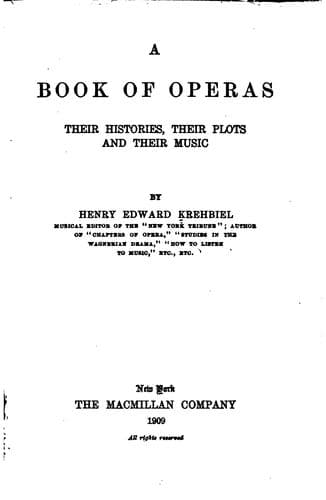
A Book of Operas: Their Histories, Their Plots, and Their MusicKrehbiel, Henry Edward
History
A Book of Operas: Their Histories, Their Plots, and Their Music
Krehbiel, Henry Edward
Operas -- Stories, plots, etc.
Words and music come from the mouth of Gretel when she releases
Hänsel from the spell in the third act, and from that of Hänsel when
he performs the same office for the gingerbread children. After two
phrases of minor significance there comes the "Theme of Fulfilment,"
so called because of its association with the answer to the prayer
for protection in the woods. Thus it forms part of the dawn music at
the beginning of the third act when the children are awakened by the
Dewman. It makes up the original part of the song of this Dawn Fairy
and is the melody to which Hänsel and Gretel sing their explanation
to the wondering gingerbread children:--
The angels whispered in dreams to us in silent night
What this happy day has brought to light.
[Musical excerpt]
There is a fourth theme, the "Theme of Rejoicing" which is the
inspiration of the dance which the gingerbread children execute
around Hänsel and Gretel to celebrate their release from the
enchantment put upon them by the wicked Witch.
At the parting of the curtain we see the interior of the hut of a
poor broom-maker. Specimens of his handiwork hang upon the walls. A
tiny window beside the door in the background, shows a glimpse of
the forest beyond. Hänsel and Gretel are at work, he making brooms,
she knitting. Gretel sings an old German folk-song, beginning thus:--
[Musical excerpt--"Suse liebe suse was raschelt im stroh?"]
All the melodies in this act have a strong family resemblance, but
this song, a cradle song of the long ago, is the only one not
composed by Humperdinck. Miss Constance Bache has failed, in her
English translation, to reproduce the quaint sentiment of the
old song, which calls attention to the fact that all geese are
shoeless. It is not for want of leather,--the shoemaker has that in
plenty,--but he has no lasts, and so the poor things must needs go
barefoot. The song invites a curious historical note. "Suse" and
"Sause" were common expressions in the cradle songs which used to be
sung to the Christ-child in the German churches at Christmas when
the decadent nativity plays (now dwarfed to a mere tableau of the
manger, the holy parents, and the adoring shepherds and magi) were
still cultivated. From the old custom termed Kindeiwiegen, which
remained in the German Protestant Church centuries after the
Reformation, Luther borrowed the refrain, "Susaninne" for one of his
Christmas chorales. The beginning of the little song which Gretel
sings used to be "Sause liebe Ninne," which, of course, is Luther's
"Susaninne." The song dominates the whole of the first act. Out
of portions of its melody grows a large part of the instrumental
accompaniment to the melodious recitative in which the dialogue is
carried on. Through expressive changes, not only in this act, but
later also, it provides a medium for much dramatic expression. A
little motif with which the orchestra introduces it develops into
a song, with which Hänsel greets his sister's announcement that
Public-domain text, read in full here on John Shaqi.
Reviews
Reviews
No reviews yet
Be the first to share your thoughts on this work.
Elsewhere in the archive
Join the Discussion
Join the discussion
Sign in to leave a comment or review.
Sign InorCreate an account