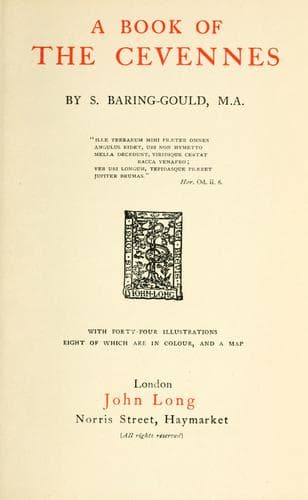
Cévennes Mountains (France); France -- Description and travel
"The peasants of the low hills of the Monts d'Orb are less
accessible to superstition than those of the highlands, but they
have less character and veritable greatness. The sun has not only
heated their land, it has also sucked up from their brains all
those vapours full of poetry that make of the men of the causses a
type original and picturesque. Between the inhabitant of Servier,
who never sowed a seed, and he of Camplong, who gets fuddled on
new wine, the distance is immeasurable, and yet they are parted by
nothing more than the granite mass of Bataillo."
This is what Fabre says of the natives. There are two types not due to
difference of blood, but of surroundings and of occupations. We are now
in the department of Hérault, of Lower Languedoc, and I may be allowed
a few words on the mixture of peoples of diverse origin that have been
fused together into a homogeneous race.
From a period before history began, this country was inhabited by
populations of diverse origins, habits, and language, drawn thither by
the delicious climate, its natural resources, or simply by the chance
of migration. One fact characterises the establishment of the tribes
or nationalities in these parts; so far as we can judge, it was their
attitude towards the people who preceded them. If some of them swept
away the indigenous race, more often they planted themselves beside
the earlier population peaceably and fused with them. Most of these
invaders seem to have possessed gentle manners, and were not goaded on
by the passion for extermination, for which there was no provocation
or need, as the land was wide and rich enough to sustain all. This
mode of colonisation had the result of filling Lower Languedoc with
very heterogeneous inhabitants, the complexity of which explains the
apparent contradictions of early writers. But on one point these
writers are unanimous: the variety of races or mixtures that occupied
the land in Gallia Narbonensis. In the first century before Christ,
Cicero notices this; and in the fourth century after Christ, Ausonius
sang: "Who can record all thy ports, thy mountains and thy lakes, who
the diversity of thy peoples, their vestures and their languages?"
Public-domain text, read in full here on John Shaqi.
Reviews
Reviews
No reviews yet
Be the first to share your thoughts on this work.
Elsewhere in the archive
Join the Discussion
Join the discussion
Sign in to leave a comment or review.
Sign InorCreate an account