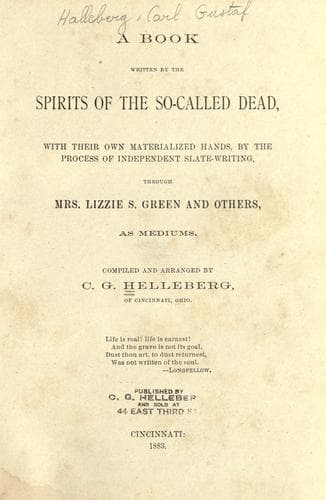
A Book Written by the Spirits of the So-Called Dead
Religion
A Book Written by the Spirits of the So-Called Dead
Spiritualism
It was a large, very beautiful, quite fresh flower, which I now have
preserved in a glass jar with deodorized alcohol. On seeing this flower my
wife's idea was that the flower had been brought from some garden, and I
thought the spirits made it, which caused me, at a slate-writing seance
the 24th of October, to ask which of us was right. On the slate was this
answer:
"Mary and I, with the assistance of the medium's band, _created it_ for
you and dear mamma, and you will find a dove in the center."
On a close examination we found to our astonishment a small dove there.
CHAPTER VIII.
SURE IDENTITY OF MY FATHER-IN-LAW--MADAM EHRENBORG WRITES TO ME IN
SWEDISH.
On the 8th of December, 1881, I and my wife had a slate-writing seance in
the forenoon, and were present in the evening at a trumpet seance with
Mrs. Green, and as my wife received a strong convincing test through the
name of her father, it is necessary before relating the facts to make a
short sketch of a part of his life. He was a Swedish nobleman, named Otto
Jacob Natt och Dag, who, by the favor of the dethroned King Gustaf Adolf
the Fourth, was educated in the military academy, and afterwards served as
officer in a rank regiment in Stockholm, which the new King Charles the
Fourteenth, Johan, the former Napoleon's General Bernadott, looked upon
with great favor. This young nobleman wrote an anonymous book about
reorganizing the Swedish army, in which many good and necessary reforms
were proposed. This book was not intended for sale, but a few copies had
been printed for his intimate friends. Some of his so-called friends
reported this, and mentioned his name to the King, who became enraged that
a young officer should dare to have the impertinence to interfere with his
business, and want to teach him, who had such a vast experience in
military affairs, the consequence of which was that he was transported to
serve in a common infantry regiment, far up in the northern part of the
country, a long distance from his near and dear relatives. Such treatment
naturally made him feel bad, and he asked permission to travel in foreign
countries, which he got, and went straight to Baden, in Germany, where he
called on his former King, Gustaf Adolf, and was kindly received. There he
republished his book in the German language, with some additions, which
the Swedish minister reported to the King, who then considered him a
traitor, and ordered his arrest, but his Swedish friends informed him of
this in time, and he went to America under the name of Frederick Franks,
which was the name of a German student, who gave him his passport, and
which he afterwards adopted and used until his death. The King, Charles
the Fourteenth, had him adjudged, unheard and absent, by a court for high
treason, for daring to pay a visit to the dethroned King, and the judgment
was that he should lose his place and rank in the army. Many years
afterwards the King regretted his harsh and unjust treatment of his
Public-domain text, read in full here on John Shaqi.
Reviews
Reviews
No reviews yet
Be the first to share your thoughts on this work.
Join the Discussion
Join the discussion
Sign in to leave a comment or review.
Sign InorCreate an account