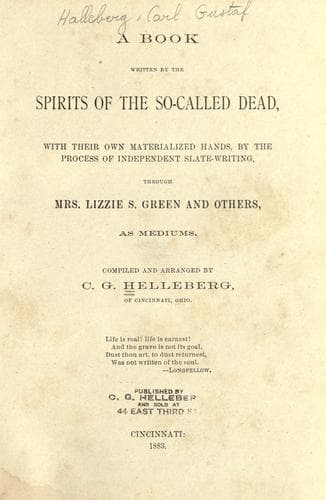
A Book Written by the Spirits of the So-Called Dead
Religion
A Book Written by the Spirits of the So-Called Dead
Spiritualism
"In the formation of your present system of government three co-ordinate
branches were established--the Executive, Legislative, and Judicial--and
they were designed to be checks, one upon the other. If in the zeal and
frenzy of partisan strife, or under the baleful influence of venality and
corruption, the legislative department should exceed its constitutional
authority or enact legislation inimical to the public interests, the
executive was invested with the veto privilege whereby the evil might be
arrested. If, however, the President should be found to be in accord and
sympathy with the legislative branch in its hurtful legislation, and gave
thereto the sanction of his approving signature; or, in case the President
exercised his veto power in the particular matter, and Congress should
pass the measure over his objections by the requisite two-thirds of each
branch, then and in either of these events there still remained the
supreme court with its supervisory power or power of final determination.
"But it may be very properly asked, what if the supreme court should be
influenced by the same or similar considerations as the other co-ordinate
branches, what help, relief, or remedy, is left to the people and the
nation? It can only be answered--force, revolution, rebellion. Does not
this plain statement present a dangerous contingency and indicate a
palpable weakness?
"It should be remembered that in our form of republican government all
powers are derived from the people, and it should be furthermore very
emphatically understood that all powers belong to them. If this view is
correct, then in the hypothetical case mentioned for the purpose of
illustration, the people themselves should be the last court of resort, or
the high court of appeals.
"It was thought by the founders of your government that the judiciary
would always be pure and safe, but unfortunately experience has taught us
quite differently. It is humiliating to an American citizen, whether he be
in or out of the body, to be compelled to make this confession. But truth
not only justifies but demands it, and it is best that it be frankly made
and acknowledged."
August 14, 1882:
"We are not permitted, for prudential reasons, to tell you how the new
system is to be fashioned. To do so would not facilitate its
accomplishment, but might possibly operate detrimentally by inducing
premature consideration and discussion. Suffice it to say that the subject
has been deliberately considered and the plan carefully matured by wise
statesmanship in the realm of causation, and will be given to your world
at the proper time and in the proper way.
"I desire to briefly discuss two propositions:
"1st. What are the duties of the citizen to the government, or what the
government has the right to exact of and from the citizen?
"2d. What are the duties of the government to the people, or what the
people have the right to exact of and from their government?
Public-domain text, read in full here on John Shaqi.
Reviews
Reviews
No reviews yet
Be the first to share your thoughts on this work.
Elsewhere in the archive
Join the Discussion
Join the discussion
Sign in to leave a comment or review.
Sign InorCreate an account