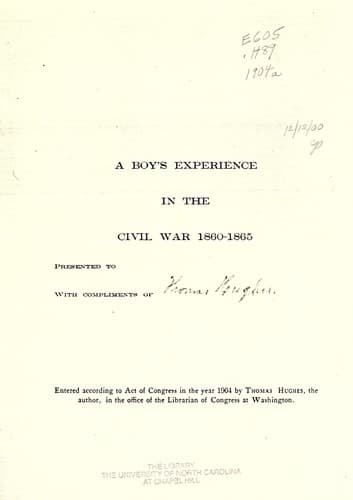
A Boy's Experience in the Civil War, 1860-1865Hughes, Thomas
History
A Boy's Experience in the Civil War, 1860-1865
Hughes, Thomas
United States -- History -- Civil War, 1861-1865 -- Personal narratives, Confederate
A curious occurrence took place daily in Capitol Square in the morning
before breakfast. A company of decrepit old men, all I think without
exception were thus, assembled on the broad walk along the Capitol
facing Capitol Street to drill as soldiers. The only striking quality
about them was their evident inability for service from old age and yet
the cheerfulness and zeal with which they handled their muskets and went
through simple evolutions evidenced a spirit unconscious of non utility.
This company shortly before Richmond was evacuated was succeeded at the
same place and at the same time daily by an equally curious assemblage
and that was a company of negroes, intended to form the embryo negro
troops for the Confederate army. I have heard it often declared that no
negro troops were ever enlisted on the Southern side. For a considerable
time before the war ended the enlistment of negroes as troops was
earnestly deliberated and the efforts in this direction in the Virginia
Legislature led to the formation of this Company of State troops. My
father as a member of the Legislature warmly advocated the enlistment of
negroes, having made an elaborate argument in the House of Delegates for
that purpose.
This company of negroes comprised about fifty or sixty men, about 25 or
30 years of age, were almost entirely dark mulattoes, wore no uniforms,
indeed few soldiers in the Confederacy wore uniforms except the officers
and most of theirs were shabby and old. The striking peculiarity about
this negro company was one that had appeared to possess the company of
old men, namely that while evidencing interest in their drill it
appeared to be for only momentary purposes and it all seemed to be
viewed as without any subsequent purpose. And the peculiarity about the
negro company was that they appeared to regard themselves as isolated or
out of place, as if engaged in a work not exactly in accord with their
notions of self interest, no doubt attributable to the fact that their
inclination must have been against engaging on the Southern side. Their
reward for enlistment I believe was to be freedom from slavery. The life
of a free negro in a slave holding country was however not a very
attractive one. He was usually shunned by the slaves, who were jealous
of him and from whom he usually held aloof and the whites regarded him
with suspicion as unreliable and indifferent.
Public-domain text, read in full here on John Shaqi.
Reviews
Reviews
No reviews yet
Be the first to share your thoughts on this work.
Join the Discussion
Join the discussion
Sign in to leave a comment or review.
Sign InorCreate an account