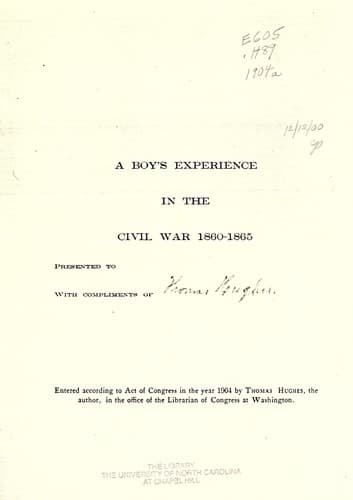
A Boy's Experience in the Civil War, 1860-1865Hughes, Thomas
History
A Boy's Experience in the Civil War, 1860-1865
Hughes, Thomas
United States -- History -- Civil War, 1861-1865 -- Personal narratives, Confederate
with no plunder from that immediate locality.
We had spent the summer of 1863 on the James river about twelve miles
above Richmond and a visit I subsequently paid there gave me an
opportunity of enjoying an experience that can never be repeated, namely
getting out of Richmond on a Confederate pass and witnessing some of the
incidents of an historical raid. My father had formed a personal
friendship with the family of General Winder, who was from Baltimore,
and as all passes had to be obtained from General Winder, who was in
command of Richmond and it was difficult to obtain access to him at his
office on Main street, I went to his house and got a pass from his son
who was his aide. With this, I boarded the canal boat on the James River
and Kanawha Canal, which boat left every evening at the foot of 7th
street for its trip up the canal. These boats were fitted to take a long
trip, uncomfortable though it might be. It was pulled by three horses
going at a rapid trot, the front one ridden by the driver who blew a
horn for the locks and the mail and to change horses. The efforts of the
drivers on freight boats on these horns were often artistic and as
musical as an accomplished bugler. Nothing of that sort was ever
attempted by the boy who rode the horses on the passenger boat. The
passengers in good weather sat on camp stools on the top of the boat and
a man at the end steered, at frequent intervals calling out “low bridge”
at which all on deck ducked their heads to avoid the low bridges which
so frequently crossed the canal from one portion of a farm to another.
The kitchen was at the end of the boat. In the long saloon on each side
was a seat running the whole length, which was converted into beds at
night. In the centre of the saloon was a long table upon which meals
were served. Just after leaving Richmond the sentry came around to
inspect the passes and verify the descriptions they contained of their
possessors. He usually completed his rounds seven or eight miles out
about the time the canal boat reached the “grave yard,” an open space
extending out from the canal and covered by water in which were sunk
worn out canal boats.
Public-domain text, read in full here on John Shaqi.
Reviews
Reviews
No reviews yet
Be the first to share your thoughts on this work.
Join the Discussion
Join the discussion
Sign in to leave a comment or review.
Sign InorCreate an account