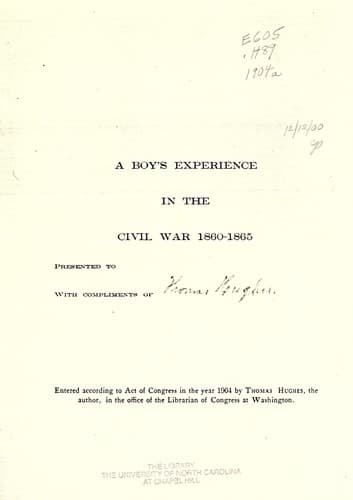
A Boy's Experience in the Civil War, 1860-1865Hughes, Thomas
History
A Boy's Experience in the Civil War, 1860-1865
Hughes, Thomas
United States -- History -- Civil War, 1861-1865 -- Personal narratives, Confederate
One of the most remarkable features of the war was the intense animosity
engendered among neighbors with sympathies on opposite sides. Those who
were formerly most intimate friends now became most bitter enemies, not
only ceasing all intercourse, but ready to inflict contumely and injury
on each other. This spirit was not so apparent in the South because with
almost unanimity the Southern people accepted the results of secession
whatever opposition they may have first offered. But in the North on the
border line where there was a numerous Southern element within the
Northern lines this bitter antagonism was pronounced, the more so
against all known to be in sympathy with the South. No more typical
place existed for this than Baltimore. In the towns and cities of what
is now West Virginia the same conditions existed. From Baltimore and
Maryland large numbers had gone South to engage in the service. Besides
these associations with the Confederate soldiers from Maryland very many
of whom came from some of the wealthiest and most prominent families of
the State were the business and social ties that had grown up between
the South and Baltimore as the Southern metropolis, so that with few
exceptions the leading people of the city were in sympathy with the
Southern cause. In many cases confiscation of the property of those who
had gone south took place, confined of course under the Constitution to
the life of the party affected. In other cases arrests were made under
the smallest pretexts, all sorts of persecutions little and great were
indulged in towards the Southern sympathizers, espionage being one of
the numerous annoyances. Relationship whether near or remote seemed to
make slight difference, and it seems now almost impossible to account
for the bitterness engendered. Of course material interests were
originally responsible, and no doubt the divergent views over whether
the state should or not secede, with the results that would affect such
material interests and the high pitch to which the contentions over the
matter wrought up the advocates pro or con were the causes that led to
the bitterness that existed. The Southerners were styled
“secessionists,” “rebels”, “traitors”, “copperheads”, with the soldiers
however a Southern soldier was always “Rebel” or a “Johnny Reb”. The
favorite popular ballad commenced something like “We’ll hang Jeff Davis
on a sour apple tree.” In the South on the other hand there was but one
name for the Northerner and whether soldier or civilian he was
invariably called “yankee”. Deep down in the Southern heart however
there was no recognition of a social relation with neighbors of Northern
sympathies and for some years after the war ended I knew of instances of
Southern women, who in marrying Union army officers were regarded not
only as having impaired their social status but as having done an act to
reflect upon their own family standing. And at the close of the war, in
Public-domain text, read in full here on John Shaqi.
Reviews
Reviews
No reviews yet
Be the first to share your thoughts on this work.
Join the Discussion
Join the discussion
Sign in to leave a comment or review.
Sign InorCreate an account