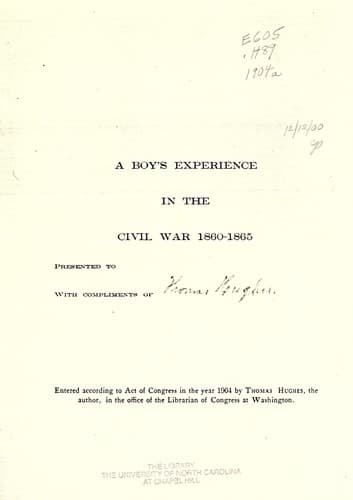
A Boy's Experience in the Civil War, 1860-1865Hughes, Thomas
History
A Boy's Experience in the Civil War, 1860-1865
Hughes, Thomas
United States -- History -- Civil War, 1861-1865 -- Personal narratives, Confederate
A topic of constant discussion is the effect of the war so far as the
negro is concerned. I have seen the negro in slavery before and during
the war and now a freedman for forty years since the war closed and I
feel that I am capable of expressing an opinion upon the subject. As a
slave he was generally well treated, and was generally contented and
happy. He was usually free from care or responsibility, all his wants
being provided for by his master. He had a task to perform and the
performance of it was exacted of him, sometimes this task was
exceedingly light, it was scarcely ever severe. It was natural he should
wish to be able to essay or not to essay this task as his humor
suggested to him and the wish for this I believe was the principal
incentive for freedom to most of the slaves. Very many I believe gave
the matter of freedom no consideration and cared nothing about it. When
the close of the war brought freedom to the vast body of those who were
slaves their reasoning suggested to them as it did to very many of the
less informed whites that the war had been fought purely to free the
negro. The corollary to this in the mind of the negro was that they were
the equal of the whites, and immediately upon the close of the war the
teaching inculcated among themselves with greatest assiduity was the
matter of equality. During the lapse of forty years however the question
of equality has in a measure worked itself out as it always does
dependent upon personal and material factors. When persons occupy grades
of servants, laborers, mechanics, storekeepers, merchants and
professional men the question of color in that all are black will not
put them on an equality one with the other and the question of equality
is not helped by trying to extend the equalizing so as to put the
colored man whatever his condition in life on a level with the white man
whatever his condition. This was a struggle so patent in the case of the
freedmen immediately after the close of the war that was bound in the
course of years to disappear from the hopelessness of it. The result is
that from my observation the negro has measurably been bettered after
the many years that have elapsed since the war, so that now his
deportment and manners are better, he is more honest and he has not
deteriorated as a worker and he is getting nearer to the deportment he
possessed before his character was disrupted by the harmful teachings of
those idealists in the New England States who professed before and
during the war to be his only true friends.
Public-domain text, read in full here on John Shaqi.
Reviews
Reviews
No reviews yet
Be the first to share your thoughts on this work.
Join the Discussion
Join the discussion
Sign in to leave a comment or review.
Sign InorCreate an account