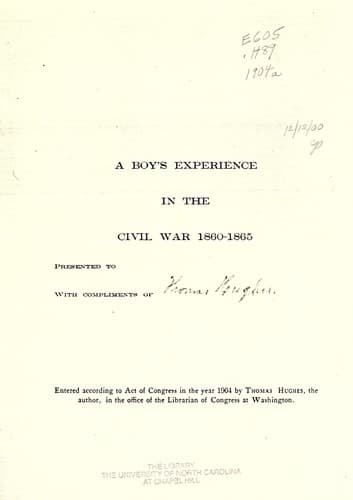
A Boy's Experience in the Civil War, 1860-1865Hughes, Thomas
History
A Boy's Experience in the Civil War, 1860-1865
Hughes, Thomas
United States -- History -- Civil War, 1861-1865 -- Personal narratives, Confederate
The life on a large plantation for a negro slave was an almost ideal
life. Each plantation of from about five hundred to several thousand
acres with its several hundred slaves was a perfect community in itself.
Every trade and occupation necessary to the effective running of the
plantation was represented. One of the slaves was a skilled blacksmith
and wheelwright, another a competent carpenter, still another a
shoemaker and so on throughout the list of utilities. In the order of
dignity and preferment the house servants came first. There were plenty
of them in every household and the work assigned to each was exceedingly
light, they were dressed well, ate the same food used by the family,
were well trained both mentally and morally, participated from the ties
of interest that bound them to the family in its pleasure to a greater
extent than could have been experienced by hired servants and in
sickness or trouble were cared for with a tenderness no less than would
be shown to a favorite child. Next in the order of regard came the
coachman, the gardener, the assistant overseer, who was always a slave;
indeed all whose duties brought them more especially in frequent contact
with the whites on the plantation. Then came the field hands, both men
and women, and no happier lot of human beings in their work could be
found than were ordinarily these same people whatever might be the task
to which they were assigned. I have been with them in hoeing corn, in
cutting wheat, in threshing grain, in curing tobacco, indeed in every
work which went on and I speak from my own personal experience in
stating as I do the spirit with which they worked. Every provision was
made for their well being, self interest of the master, independent of
dictates of humanity, and pressure of public opinion required this. The
negro quarters were sufficiently far from the house to permit of the
pleasures that appealed to the negro heart without the noise disturbing
the white folks. Each negro family usually had a cabin, ample and
comfortable, with a garden attached in which were raised vegetables and
the hours of field labor were such as to leave ample time to cultivate
this garden. Rations of staple food were served with the same regularity
and provisions for health and comfort as in army life. They were
supplied with ample clothing. Whether in health or sickness and from
birth to death the care of his slaves was the first regard of the slave
owner, and an exception to such was not tolerated in the community. The
family bible of the master’s family first contained the births, deaths
and marriages of the members of his family, then in the same bible
followed exactly similar entries with reference to his slaves. The
members of his family became the instructors of the negro children in
Sunday school work. The adult negroes were given ample opportunity and
encouraged to attend religious meetings. The negro slave was indeed
Public-domain text, read in full here on John Shaqi.
Reviews
Reviews
No reviews yet
Be the first to share your thoughts on this work.
Join the Discussion
Join the discussion
Sign in to leave a comment or review.
Sign InorCreate an account