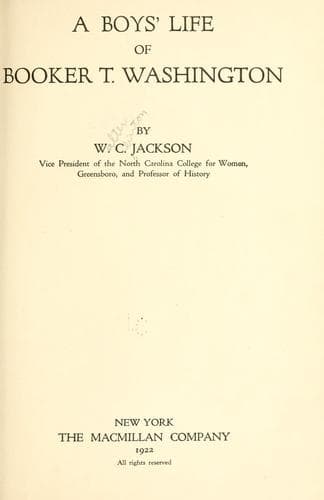
A boys' life of Booker T. WashingtonJackson, Walter Clinton
History
A boys' life of Booker T. Washington
Jackson, Walter Clinton
African American educators -- Biography -- Juvenile literature; Washington, Booker T., 1856-1915 -- Juvenile literature
A BOYS’ LIFE OF BOOKER T. WASHINGTON
[Illustration:
SYMBOLIC GROUP ERECTED AT TUSKEGEE INSTITUTE (1922).
]
A BOYS’ LIFE
OF
BOOKER T. WASHINGTON
BY
W. C. JACKSON
Vice President of the North Carolina College for Women, Greensboro, and
Professor of History
NEW YORK
THE MACMILLAN COMPANY
1922
All rights reserved
PRINTED IN THE UNITED STATES OF AMERICA
COPYRIGHT, 1922,
BY THE MACMILLAN COMPANY
Set up and electrotyped. Published June, 1922
PREFACE
The single aim in telling the story that follows is to interest boys in
the life of Booker T. Washington.
This man’s life was of such singular and vital importance in the history
of his own race and in the history of our country that it ought to be
familiar to all the youth of the land, and to the negro youth
especially, since it is the greatest inspiration to the latter to be
found in the annals of American history.
There has been no attempt to be original or exhaustive in the treatment.
While a great mass of material has been consulted, it should be frankly
stated that the story follows very closely the material found in
Washington’s “Up from Slavery” and “My Larger Education” and Scott and
Stowe’s “Booker T. Washington: Builder of a Civilization.”
The author desires to acknowledge his indebtedness to Doubleday, Page
and Company for permission to use extensive quotations from these books.
If some boy by reading this book is inspired to higher ambition and
encouraged to nobler effort, the author will feel that the book is fully
justified.
FOREWORD
This is the story of Booker T. Washington. It is the story of a boy who
was born a slave and who in manhood became the leader of ten million
people; who was born in poverty and ignorance and became the greatest
orator and teacher of the negro race; who was born of an ignorant and
backward race and became the friend of the greatest and best men of all
races of all the world.
He was a brave man. He had courage and backbone. He was not afraid. He
had courage to fight for what he believed to be the right.
He was an energetic man. There was not a lazy bone in him. No man ever
lived a more strenuous life than he did. He loved his work; and few
other men ever did so much work in a lifetime.
He was just and fair-minded. He could see right for the white man as
well as for the negro. He never intentionally did any one, white or
black, an injustice.
Public-domain text, read in full here on John Shaqi.
Reviews
Reviews
No reviews yet
Be the first to share your thoughts on this work.
Join the Discussion
Join the discussion
Sign in to leave a comment or review.
Sign InorCreate an account