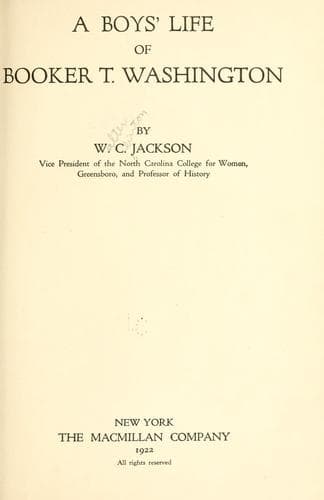
A boys' life of Booker T. WashingtonJackson, Walter Clinton
History
A boys' life of Booker T. Washington
Jackson, Walter Clinton
African American educators -- Biography -- Juvenile literature; Washington, Booker T., 1856-1915 -- Juvenile literature
In this way he came to know the people just as they lived, and they
learned how sympathetic Washington was, and how he was trying to help
them. Most of those he visited he found living in one- or two-room
houses, with fat pork and corn bread as their principal food. But they
always treated him kindly and entertained him the best they could. One
thing that distressed him was the discovery that many of these people
had been persuaded to buy such things as costly sewing machines and
organs, when they didn’t have enough to eat and to wear. At one place
where he took dinner there were four in the family, and when they sat
down at the table, he found that there was but one fork for all five of
them.
Their lives were filled with much drudgery and hard work and almost no
opportunities for improvement. It was nearly impossible for them to make
a living, much less save any money. Their schools, if they had any at
all, had very short terms and were taught by teachers who knew very
little more than the children. It was a discouraging situation to any
one except a man like Booker Washington. “These are my people,” he said.
“They need help. They need education and the kind of education that will
give them cleaner and happier homes, healthier bodies, better schools,
and better life in every way. I am going to help them.”
The school opened on July 4, 1881, with thirty students. Washington was
the only teacher. A large number of students wanted to enter, but he
decided not to admit any under fifteen years of age. Some of these
students were boys, and some were girls; some were grown men and women.
Most of them had been teachers. None of them was very well prepared,
however, for they had been very poorly taught. But the teacher found all
of them eager to learn and ready to work.
Soon there were more students calling for admission. Within six weeks
there were fifty students. It was necessary to have a new teacher, and
the person secured for this work was Olivia Davidson, who afterwards
became Booker Washington’s second wife.
She was a great help to him, and she agreed with him that they must do
something for the students besides merely teaching them books.
Washington says that they wanted to teach them how to be clean; how to
take care of their teeth and clothing; what and how to eat; and how to
make a living.
All these pupils lived on the farm, as did nearly all the people of the
South. Washington wanted to so teach them that they would continue to
live among their own people and their lives would be happier and better
in every way. He did not want them to get a false idea about education.
Many of them had the wrong impression already. They thought that getting
an education consisted in reading big books and then of being able to
earn a living without work. Both of these ideas were wrong. He wanted to
teach them something that would make them useful and happy and
prosperous on the land in their native state.
Public-domain text, read in full here on John Shaqi.
Reviews
Reviews
No reviews yet
Be the first to share your thoughts on this work.
Join the Discussion
Join the discussion
Sign in to leave a comment or review.
Sign InorCreate an account