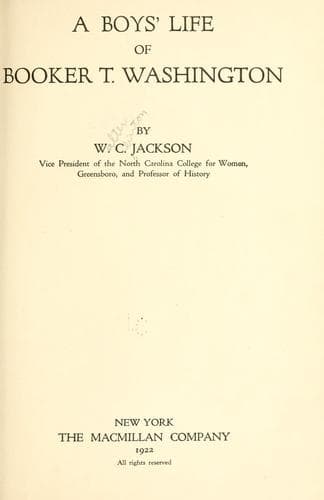
A boys' life of Booker T. WashingtonJackson, Walter Clinton
History
A boys' life of Booker T. Washington
Jackson, Walter Clinton
African American educators -- Biography -- Juvenile literature; Washington, Booker T., 1856-1915 -- Juvenile literature
It was in this state that slavery in North America began. We must
remember, however, that slavery had been in existence a long, long time.
The ancient Hebrews, we are told in the Old Testament, practiced this
evil custom. So did all the nations about Palestine. The Greeks and the
Romans also kept slaves. We must not think of the people that were
enslaved by the Hebrews and Greeks and Romans as negroes. They were of
all races. Whenever one people conquered another, it mattered not of
what race, the conquerors made their captives slaves. This often
resulted in the most cultured and highly educated people being made
slaves. This was especially the case when the Romans captured Greeks.
Later on in the history of Europe, during the sixteenth and seventeenth
centuries, the enslavement of negroes became very general, so that, by
the time North America began to be settled by the people from Europe,
negro slaves were bought and sold throughout the principal European
countries and their colonies.
So it came about that, in Virginia, negro slavery was introduced into
the United States. It was in 1619 that a Dutch ship, after a cruise in
the West Indies, landed at Jamestown, and while there, engaging in trade
with the inhabitants, sold them nineteen negroes. These were the first
slaves sold in North America, and it was from this beginning that the
system grew up in the country.
In Virginia too we had the first big plantations. Tobacco was the most
important crop in the early history of the colony. The planters could
sell tobacco at a great profit in England. Negro slaves could cultivate
tobacco very successfully. The planters, therefore, bought slaves to
raise tobacco, and they sold the tobacco and bought more slaves to raise
more tobacco. The planters bought many hundreds of acres of land and
many slaves to cultivate them. As you know, the slaves lived in cabins.
These cabins were little houses, usually built of logs, and the cracks
were daubed with mud. The cabin usually had one door, one window, and a
dirt floor only. These cabins were all close together, not very far from
the “big house,” and were known as the “quarters.”
The slaves did all the work on the plantation. Most of them worked in
the fields. Some worked about the barn and in the garden. One drove the
master’s carriage and took care of the horses. Another was the butler in
the “big house.” Some of the small boys and girls also worked in the
“big house,” serving their young masters and mistresses. And, of course,
one of the negro women was the plantation cook.
Public-domain text, read in full here on John Shaqi.
Reviews
Reviews
No reviews yet
Be the first to share your thoughts on this work.
Join the Discussion
Join the discussion
Sign in to leave a comment or review.
Sign InorCreate an account