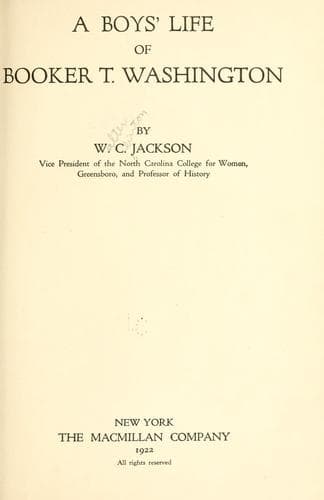
A boys' life of Booker T. WashingtonJackson, Walter Clinton
History
A boys' life of Booker T. Washington
Jackson, Walter Clinton
African American educators -- Biography -- Juvenile literature; Washington, Booker T., 1856-1915 -- Juvenile literature
Everybody expected Washington to accept some kind of political position,
but he steadfastly refused. Time after time, men of his own race and
white men urged him to run for office, or accept an appointment by the
President to high office. This he absolutely refused to do. He said that
his service, whatever it was worth, would be given, not in politics but
in education. He believed that entirely too much emphasis had been
placed on holding office by the negro, just after the war. He was more
concerned about whether or not his people could have the opportunity to
earn an honest living than he was about getting some political job.
He was often misunderstood about his ideas on holding office and the
whole question of the part the negro should take in politics; for he was
convinced that there were other things far more important at that time
to the negro than the matter of voting.
There was one phase of politics, however, that Washington did keep in
close touch with. This can be best explained by giving some of his
correspondence.
“Theodore Roosevelt, immediately after taking the oath of office as
President of the United States, in Buffalo, after the death of President
McKinley, wrote Mr. Washington the following note:
BUFFALO, N. Y.
_September 14, 1901_.
Dear Mr. Washington:
I write you at once to say that to my deep regret my visit South must
now be given up.
When are you coming North? I must see you as soon as possible. I want
to talk over the question of possible appointments in the South
exactly on the lines of our last conversation together.
I hope my visit to Tuskegee is merely deferred for a short season.
Faithfully yours,
(Signed) Theodore Roosevelt.
Booker T. Washington, Esq.
Tuskegee, Ala.
“In response to the above note Mr. Washington went to the White House
and discussed with the President ‘possible future appointments in the
South.’”[32]
Immediately following this conference with the President, there was a
vacant judgeship in Alabama which gave the President an opportunity to
carry out his ideas about Southern appointments. He called upon
Washington for advice, and Washington, being unable to go himself at the
time, sent his secretary, Emmett J. Scott, to Washington as his
representative. Largely upon the recommendation of Washington, Judge
George Jones, a Democrat, was appointed to this position. This was an
event of great significance indeed, when a Republican President of the
United States appointed a Southern Democrat to office. It was done in
accordance with the ideas of both the President and Washington,—that
only men of the highest fitness, regardless of color or party, should
receive appointment.
From this time on, Washington was one of the President’s chief advisers
in Southern appointments.
Public-domain text, read in full here on John Shaqi.
Reviews
Reviews
No reviews yet
Be the first to share your thoughts on this work.
Elsewhere in the archive
Join the Discussion
Join the discussion
Sign in to leave a comment or review.
Sign InorCreate an account