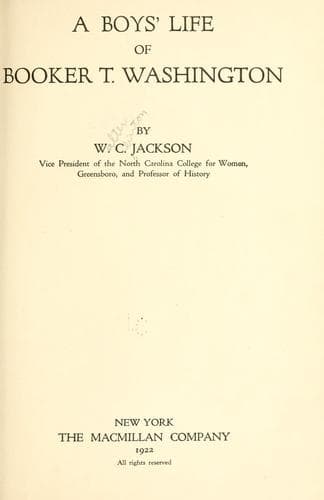
A boys' life of Booker T. WashingtonJackson, Walter Clinton
History
A boys' life of Booker T. Washington
Jackson, Walter Clinton
African American educators -- Biography -- Juvenile literature; Washington, Booker T., 1856-1915 -- Juvenile literature
President Roosevelt, of course, appointed many negroes also. He believed
that, when negroes possessed the proper qualifications for offices, they
should have a share in them. Washington did not try to get very many
negroes appointed, but he did try to get the very best negro when one
was appointed. In other words, he was trying to improve the quality
rather than increase the quantity of negro officeholders. After one of
Washington’s speeches, in which he laid special emphasis on this idea,
President Roosevelt sent him the following letter:
My dear Washington:
That is excellent; and you have put epigrammatically just what I am
doing—that is, though I have rather reduced the quantity, I have done
my best to raise the quality of Negro appointments.
With high regards,
Sincerely yours,
Theodore Roosevelt.[33]
Throughout the administrations of President Roosevelt and President
Taft, Washington was constantly called into conference and rendered a
lasting service to his own race and to the people of the country in
giving wise counsel, not only about politics but about a great many
things pertaining to the welfare of his people.
Washington was often criticized very severely by members of his own race
for his position with reference to voting. His ideas on this question
are well stated in the following quotation:
“I am often asked to express myself more freely than I do upon the
political condition and the political future of my race.... My own
belief is, although I have never before said so in so many words, that
the time will come when the negro in the South will be accorded all the
political rights which his ability, character, and material possessions
entitle him to. I think, though, that the opportunity to freely exercise
such political rights will not come in any large degree through outside
or artificial forcing, but will be accorded to the negro by the Southern
white people themselves, and that they will protect him in the exercise
of these rights. Just as soon as the South gets over the feeling that it
is being forced by ‘foreigners’ or ‘aliens’ to do something which it
does not want to do, I believe that the change in the direction that I
have indicated is going to begin.”[34]
Again he says: “I contend that, in relation to his vote, the negro
should more and more consider the interests of the community in which he
lives, rather than seek alone to please some one who lives a thousand
miles from him and his interests.”[35]
Public-domain text, read in full here on John Shaqi.
Reviews
Reviews
No reviews yet
Be the first to share your thoughts on this work.
Elsewhere in the archive
Join the Discussion
Join the discussion
Sign in to leave a comment or review.
Sign InorCreate an account