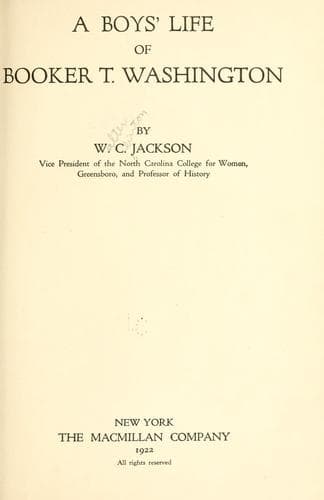
A boys' life of Booker T. WashingtonJackson, Walter Clinton
History
A boys' life of Booker T. Washington
Jackson, Walter Clinton
African American educators -- Biography -- Juvenile literature; Washington, Booker T., 1856-1915 -- Juvenile literature
In 1899 he made a speech in Boston, and some of his friends noticed that
he seemed extremely tired. He remained in Boston several days. One day
during his stay a friend asked him if he had ever been to Europe. He
replied that he had not. He was asked very casually whether he thought
that he would enjoy a trip to Europe. He said that he certainly would,
but he did not ever expect to have such a pleasure. A day or two later
some of his friends came to him and told him they had a little surprise
for him, that they had made arrangements for him and his wife to go to
Europe in the summer and spend several months on a vacation.
Washington was very greatly surprised. He thanked his friends very
cordially for their interest but told them that he could not afford to
take the trip. Whereupon they told him that all the money for the
expenses of the trip had already been raised, and that it would not cost
him a cent. He thanked them again very sincerely but told them he could
not think of leaving his work that long,—that money had to be raised for
Tuskegee, and that he had to stay right on the job to get it. Then they
told him that a group of his friends had already raised enough money to
keep Tuskegee going until he got back. He then gave another excuse. He
was afraid people would say that he was “stuck up”; that since he had
made some success in the world he was trying to show off and play the
big man. His friends told him that sensible people would not think such
a thing, and that he need not bother about the people who had no sense.
Washington thought, too, that he had no right to quit work so long. He
had worked all his life. There was a world of work yet he had to do. To
go off on a vacation of several months, when there was so much to be
done, and when other people were at work, seemed wrong to him. But he
realized finally that a reasonable amount of rest, when one is tired,
means more and better work in the long run.
So it came about that, on May 10, 1899, Washington and his wife went
aboard the ship _Friesland_ in New York harbor and sailed for Europe. It
was a wonderful experience for Washington. In the first place, as he
went aboard the ship, he received a message from two of his friends
telling him that they had decided to give him the money to build a
magnificent new building at Tuskegee. That was a good “send-off.”
Washington was a bit uneasy about how people would treat him aboard
ship. He knew what unfortunate experiences some members of his race had
had in times past. But the captain received him cordially, and everybody
on board was exceedingly courteous to him and to his wife in every way.
Washington on his way to Europe! It seemed to him like a dream. Again
and again he had thought of Europe,—much as he did of heaven,—a goodly
place, but far away. It had never even occurred to him that he would
ever go to Europe. And now he was on his way! He was like a schoolboy;
he was happy over the prospect of a wonderful trip.
Public-domain text, read in full here on John Shaqi.
Reviews
Reviews
No reviews yet
Be the first to share your thoughts on this work.
Elsewhere in the archive
Join the Discussion
Join the discussion
Sign in to leave a comment or review.
Sign InorCreate an account