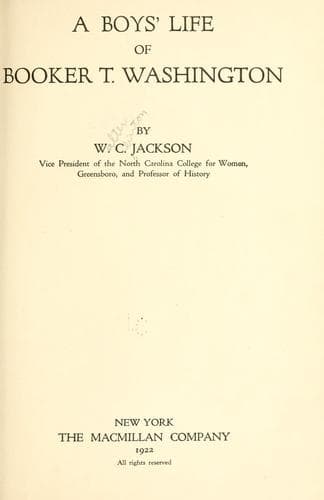
A boys' life of Booker T. WashingtonJackson, Walter Clinton
History
A boys' life of Booker T. Washington
Jackson, Walter Clinton
African American educators -- Biography -- Juvenile literature; Washington, Booker T., 1856-1915 -- Juvenile literature
While he believed, theoretically, in universal, free suffrage, he very
frankly admitted that the peculiar conditions existing in the South made
it necessary to put restrictions upon the ballot. He was opposed,
however, to any discriminations in the law; and he urged with all his
power that the negro be given good educational and business advantages,
so that he might fit himself for the full responsibilities and duties of
life.
Washington himself never had any trouble about voting. He always
registered and always voted, and no one ever raised an objection to his
doing so.
CHAPTER XIV
VISITS TO EUROPE
Washington was a great traveler. He was away from his home at least half
of each year and often more than that. He traveled principally in the
North, making speeches and interviewing people who might help Tuskegee.
While on these trips, he did most of his reading and writing. He was
very fond of newspapers and magazines. When he started on a long
journey, he surrounded himself with a large number of papers and
magazines and books, which he thoroughly enjoyed. History was his
favorite field of reading outside of newspapers and magazines. He was
especially fond of biography—of reading about real men, men of action
and thought and great talents. Much of his greatest inspiration as a boy
came from reading the lives of great men. Lincoln was his greatest hero.
He said that he had read practically every recorded word of Lincoln’s.
Washington also did much of his writing on these trips. He kept his
stenographer with him all the time, and, when he was not reading, he was
usually dictating a speech, or a letter, or an article for a magazine. A
large part of his greatest book, “Up from Slavery,” was written while he
was on the train or waiting at stations between trains. It is remarkable
that he should have been able to accomplish so much under such
circumstances, for traveling was hard work. He often had to get up in
the middle of the night to catch a train and then ride all day, often
without Pullman accommodations. He said that he had slept in three
different beds in one night, so broken was his rest and so often did he
have to change trains in order to keep engagements. Undoubtedly it was
this hard traveling that helped to break down his great strength and
wear him out.
[Illustration:
BOOKER T. WASHINGTON, FIRST PRINCIPAL OF TUSKEGEE INSTITUTE
]
Public-domain text, read in full here on John Shaqi.
Reviews
Reviews
No reviews yet
Be the first to share your thoughts on this work.
Elsewhere in the archive
Join the Discussion
Join the discussion
Sign in to leave a comment or review.
Sign InorCreate an account