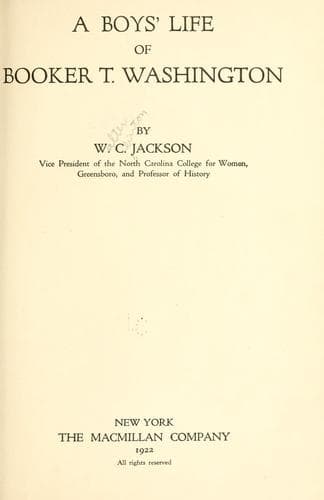
A boys' life of Booker T. WashingtonJackson, Walter Clinton
History
A boys' life of Booker T. Washington
Jackson, Walter Clinton
African American educators -- Biography -- Juvenile literature; Washington, Booker T., 1856-1915 -- Juvenile literature
The American whom he found most interesting in Paris, however, was a
negro—Henry O. Tanner. Tanner is an artist, a painter. He is the son of
the beloved Bishop Tanner and was born in America. He showed marked
talent for painting in his youth. When he grew up, he determined to go
to the greatest city in the world for art. He went to Paris and became
so successful in his work that he has continued to live there. He has
several paintings in the Louvre, the greatest and most exclusive art
gallery in the world. A picture cannot be put in the Louvre unless it is
recognized and accepted as a great work of art. Washington spent much
time with Tanner and was greatly pleased to see what marked success had
been won by this American negro. He took it as proof of his contention
that, when a negro proves himself really worthy, he will be recognized
and honored, for Tanner enjoyed the esteem and regard of all his
associates, regardless of race. And they esteemed him because of his
worth, and not because of his color.
From Paris the Washingtons went to London. Here they visited many places
of historic interest,—the British Museum, Westminster Abbey, St. Paul’s,
and the House of Commons. They met many interesting people,—the Duke and
Duchess of Sutherland, Joseph H. Choate, American ambassador to England,
Henry M. Stanley, the great African explorer, with whom Washington
conversed at length. They were also received by Queen Victoria, at
Windsor Castle.
It had been a wonderful trip. Washington had learned many lessons from
the Old World. He had seen and talked with men who helped him in the
better understanding of his own great task. He had had a wonderfully
good time. He was thoroughly rested—a new man. He plunged into his work
again upon his return with great vigor and enthusiasm.
Washington made two other trips to Europe during his lifetime. The
second one was largely like the first—a trip for recreation and pleasure
and rest. But the third trip was undertaken with a serious purpose. He
wanted to see how the poor people of Europe lived, and how their living
conditions compared with those of the workingman in the United States.
He was particularly anxious to see how conditions there compared with
those affecting the negro population of the South. He also wanted to see
whether or not he could find anything in Europe that would justify the
system of education he had established at Tuskegee. So this time he left
the usual highways of travel and went far into the interior, visiting
the peasant in his hut, in the remotest regions of the country,—the
miner toiling underground, the laborer in the quarry, and the poor man
at his work whatever it was and wherever he could be found. He visited
the farms in the remote parts of Poland, Austria, and Italy. He went to
the sulphur mines in Campo Franco. At Catania he saw the grape harvest
and the men barelegged, treading the wine press as they did in Bible
times.
Public-domain text, read in full here on John Shaqi.
Reviews
Reviews
No reviews yet
Be the first to share your thoughts on this work.
Elsewhere in the archive
Join the Discussion
Join the discussion
Sign in to leave a comment or review.
Sign InorCreate an account