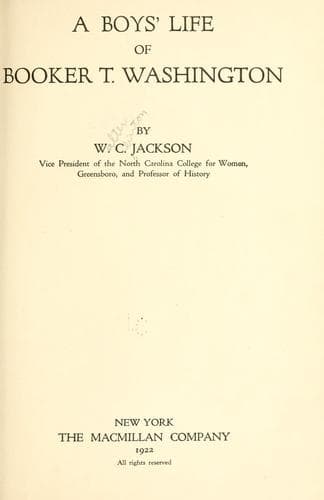
A boys' life of Booker T. WashingtonJackson, Walter Clinton
History
A boys' life of Booker T. Washington
Jackson, Walter Clinton
African American educators -- Biography -- Juvenile literature; Washington, Booker T., 1856-1915 -- Juvenile literature
In a very remote part of Poland, away up in the mountains, he stopped at
a little thatched-roof cottage. Desiring to see how the place looked on
the inside, he knocked at the door. In response a man opened the door,
and Washington said something to him in English, thinking, of course,
that the man would not understand, but that he would be able to see
inside the hut. To his utter astonishment, the man answered him in
English. Upon further conversation, he found that this man had once
lived in Detroit, Michigan.
When he was in the mines at Campo Franco, Sicily, he by chance met a man
who had once worked in the mines near Malden, West Virginia, where
Washington himself had worked when a boy. The world is not such a big
place after all!
As a result of his observations of conditions in Europe, Washington came
to the conclusion that the negro in the South is, generally speaking, in
far better condition than the peasant of Europe. He also noted that,
wherever conditions were fairly good, where the natives owned the land
and had developed reasonably good farming conditions, there was no
emigration from that region to America. But where conditions were bad,
where farms were not well kept, where the people were not permitted or
encouraged to own their own homes, from such sections there was always
much emigration to America. In other words, good local conditions, land
ownership, good schools, and so on, tended to make the people happy,
contented, and desirous of remaining where they were. In this fact he
saw a great lesson for his own people. He believed that the South is the
home of the negro, that here it is possible for him to do his best. He
was, therefore, tremendously anxious for the negroes to learn how to
cultivate the soil to the best possible advantage, to buy land, to build
schools, to establish churches, and in every way to become real citizens
of the country where they were.
Washington wrote an interesting book describing all that he saw and
learned on this trip. It is called, “The Man Farthest Down.” As stated
before, he pointed out that there were many, many people “farther down”
than the American negro; that compared to most of the people of Europe,
he ought to be exceedingly thankful that his condition is as good as it
is. Of course he did not mean by this that conditions with the negro
were what they ought to be; but that the negro should be thankful for
the progress that he has made; that he should take courage, and go
forward to better things.
The most interesting experience of this trip to Europe was his visit to
the King and Queen of Denmark, at Copenhagen. On his first visit to the
palace he was received by the King. Washington was much impressed by the
King’s cordiality and simplicity, by his knowledge of America, and by
his acquaintance even with the work Washington was doing at Tuskegee. At
the close of the interview, the King invited him to dine at the palace
that night.
Public-domain text, read in full here on John Shaqi.
Reviews
Reviews
No reviews yet
Be the first to share your thoughts on this work.
Elsewhere in the archive
Join the Discussion
Join the discussion
Sign in to leave a comment or review.
Sign InorCreate an account