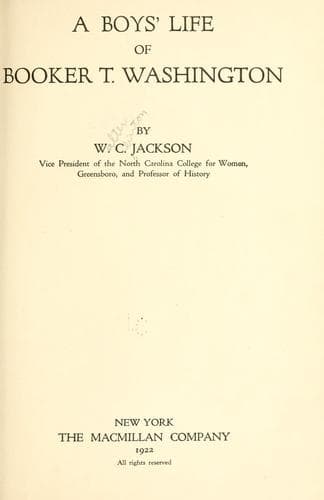
A boys' life of Booker T. WashingtonJackson, Walter Clinton
History
A boys' life of Booker T. Washington
Jackson, Walter Clinton
African American educators -- Biography -- Juvenile literature; Washington, Booker T., 1856-1915 -- Juvenile literature
Now the invitation of a king is the same as a command, and one is always
expected to accept. Of course Washington was delighted to accept this
invitation.
Washington spent the rest of the day preceding the dinner hour visiting
the country people near Copenhagen. He was late getting home, and he was
terrified when he realized that he might be late for dinner. To keep the
King and Queen waiting would be a terrible offense. He dressed as
rapidly as he could. But in his haste, he pulled his necktie to
pieces,—the only one he had fit for the occasion! He pinned it together
the best he could and put it on; but he says that he was in great
distress throughout the dinner lest the tie come to pieces again.
He reached the palace just in time for the dinner. He was taken directly
to the King, who led him to where the Queen was standing, and presented
him to her. She was very cordial and gracious. She spoke English
perfectly; and Washington was again surprised to find that she, too, was
thoroughly familiar with affairs in the United States, and that she also
knew about Tuskegee.
There was a very distinguished group of people present. The dinner was
given in the magnificent Summer Palace, and everything was truly royal
in its elegance and splendor. Washington says, “As I ate food for the
first time in my life out of gold dishes, I could not but recall the
time when as a slave boy I ate my syrup from a tin plate.”[36]
CHAPTER XV
BOOKER T. WASHINGTON: THE MAN
Booker Washington at home, with his wife and children, his garden, his
chickens, his pigs, his horses and cows, is far more interesting than
Washington the orator, the writer, the teacher, the traveler, the
college principal.
No man ever loved his home more than Washington. He had to be away from
it much of the time. He was away at least half of each year. This was a
great hardship to him, and just as often as was possible he got away
from his exacting duties and returned to Tuskegee to find rest and quiet
and comfort and joy with his own family.
He was an early riser, when at home, getting up always at 6 o’clock. His
first morning task was to gather the fresh eggs. He was very fond of
chickens and always kept a number of them. “I begin my day,” he says,
“by seeing how many eggs I can find, or how many little chicks there are
that are just beginning to creep through the shells.... I like to find
the new eggs myself, and I am selfish enough to permit no one else to do
this....”[37]
Public-domain text, read in full here on John Shaqi.
Reviews
Reviews
No reviews yet
Be the first to share your thoughts on this work.
Elsewhere in the archive
Join the Discussion
Join the discussion
Sign in to leave a comment or review.
Sign InorCreate an account